 Contact
 Help
Help






The Royal Canadian Mint: Canada’s National Mint and Refinery



The Royal Canadian Mint (RCM) is Canada’s national mint, and like the Perth Mint it is two operations rather than one: a mint that strikes coins, and an integrated precious metals refinery that turns mined metal into bars, wafers and granules. Both sit within its Sussex Drive headquarters in Ottawa, while a second plant in Winnipeg produces Canada’s circulating coinage and coins for dozens of other countries. The RCM is a federal Crown corporation, owned outright by the Government of Canada and operating as an agent of the Canadian monarch.
It is best known for one product line. The Gold Maple Leaf launched in 1979 and moved to 9999 fineness in November 1982, the first of the major bullion coins struck to that standard. The Silver Maple Leaf followed in 1988 at the same purity. Both rank among the best-selling bullion coins in the world, and platinum and palladium versions are produced alongside them. The institution behind them is considerably older: it opened in 1908 as the Ottawa branch of Britain’s Royal Mint, striking gold Sovereigns with a ‘C’ mintmark, and passed into Canadian ownership in 1931.
This guide covers who owns the Royal Canadian Mint and how it is structured, the refinery behind the coins and the accreditations it holds, the Maple Leaf range and the security features built into it, how its premiums compare with rival sovereign coins, and what buying its bullion involves from outside Canada.

Highlights
- The Royal Canadian Mint is a federal Crown corporation, wholly owned by the Government of Canada, and is both a national mint and an integrated precious metals refinery.
- It opened in 1908 as the Ottawa branch of Britain’s Royal Mint, striking gold Sovereigns with a ‘C’ mintmark, and passed into Canadian ownership in 1931.
- Bullion accounts for around four fifths of the Mint’s revenue. In 2025 it reported C$2.0 billion of turnover and sold 551,200 ounces of gold and 11.6 million ounces of silver.
- The Gold Maple Leaf launched in 1979 and moved to 9999 fineness in 1982 as the world’s first 99.99% pure gold bullion coin. Gold and silver Maple Leafs carry the Mint’s Bullion DNA security features, combining precision-machined radial lines with a laser micro-engraved security mark recorded in an encrypted database.
- The Ottawa refinery has held London Good Delivery accreditation for gold since the early twentieth century and for silver since 2011, and refines to purities of up to 99.999%.
Who Is the Royal Canadian Mint?
The Royal Canadian Mint is a federal Crown corporation, wholly owned by the Government of Canada and operating as an agent of the Canadian monarch, currently King Charles III. It has its own board of directors, chaired independently and including the Master of the Mint, and reports to Parliament through the Department of Finance. Because Canada has two official languages the Mint is also the Monnaie Royale Canadienne, and both names appear in its logo and on its refinery stamp, which turns out to be a useful detail when identifying a genuine bar.
For a national mint, the business is barely about coinage at all. In 2025 the Mint reported revenue of C$2.0 billion, of which bullion products and services accounted for roughly C$1.66 billion, better than four fifths of the total. Numismatics contributed C$182 million, coins struck for foreign governments C$75 million, and Canada’s own circulating coinage C$85 million, a little over 4% of the whole. Across that year the Mint sold 551,200 ounces of gold and 11.6 million ounces of silver in bullion form, and employed 1,173 people at the end of it.
Ottawa and Winnipeg
The Mint works from two plants, and the division between them explains where any given product comes from. Ottawa, on Sussex Drive, is the head office. It houses the refinery and produces every bullion coin and bar the Mint makes, along with commemoratives and medals, as well as the coin design, engraving and die manufacture behind them. Winnipeg is the circulation plant, a purpose-built facility striking Canada’s everyday coinage as well as coins and blanks for central banks and monetary authorities in dozens of other countries.
Both sites run guided tours throughout the year. Neither operates as a bullion counter, though the Mint does run its own retail boutiques.
A Crown Corporation Run on Commercial Terms
State ownership does not mean state funding. The Mint receives no appropriation from the Canadian government, covers its costs from its own trading, and pays dividends back to the government. There is one exception, introduced by a 2014 amendment to the Royal Canadian Mint Act. The Canadian circulation coinage programme now runs on a non-profit basis for the benefit of the Department of Finance, while bullion, foreign coinage and numismatics continue to operate for profit. That is part of why the revenue split looks the way it does.

The Royal Canadian Mint Refinery
The refinery sits inside the Mint’s Sussex Drive complex in Ottawa, and it is considerably older than the coins it is now known for. Gold refining began there in 1911, shortly after the Mint opened, and a separate purpose-built gold refinery followed in 1936 to handle the output of Northern Ontario’s expanding gold fields. The current silver refinery opened in 2005.
What arrives is doré, the crude bar that comes off a mine site at roughly 70% gold, along with recycled and industrial material. What leaves is refined metal at anything from 99.5% up to 99.999% fine, and the Mint’s refining capability is the reason the Gold Maple Leaf was able to move to 9999 in 1982 as the world’s first 99.99% pure gold bullion coin. It went further in 1998 with a 99.999% collectible issue. The refinery’s clients are mining companies across North and South America, bullion banks, recyclers, industrial users and the jewellery trade, and it offers assaying as a standalone service.
Accreditation
The Mint has been an accredited London Good Delivery refiner since the early twentieth century, and appeared on the London gold market’s first formal Good Delivery List in 1934. Its silver was accredited in 2011. Its large bars are approved for settlement of COMEX gold futures in New York, where they have been accepted since 1974, and COMEX silver since 2013, and for TOCOM gold futures in Tokyo since 1988. The refinery holds ISO 9001 certification, and the Mint is an associate member of the LBMA.
That combination is unusual in one respect worth noting. Plenty of refiners hold Good Delivery accreditation and plenty of mints strike bullion coins, but the number of institutions doing both, to that standard, in the same building, is very small.
The Bar Range
Alongside the coins, the RCM refinery produces investment bars and wafers. The gold range runs from small retail bars up to the 400 oz Good Delivery bar traded between institutions, with 1 kg bars the most widely held of the larger sizes. Silver is produced in 1,000 oz Good Delivery bars and 10 oz to 100 oz retail bars. The refinery also supplies gold and silver granules to industrial and jewellery customers.
Bars carry the Mint’s refinery stamp: the words ROYAL CANADIAN MINT and MONNAIE ROYALE CANADIENNE encircling a maple leaf. Wholesale buyers of the larger sizes include central banks, Canadian and international bullion banks, traders and funds. BullionStar stocks Royal Canadian Mint bars alongside the coins. Browse our full range of gold bars and silver bars.
Traceability and Segregated Refining
This is where the Mint has put most of its recent effort, and it addresses a question institutional buyers increasingly ask: not just how pure the gold is, but where it came from.
The refinery offers segregated refining in three forms. A client can have Canadian gold, drawn from Canadian mines generally; single-source gold, kept separate from the moment it arrives so the finished metal traces to one mine; or mixed-source gold. In 2022 the Mint used that capability to issue its first fully segregated single-mine gold bullion coin. In 2024 it added Bullion Genesis, which uses distributed ledger technology to record the provenance and chain of custody of gold through the refining process.
None of that changes what a coin is worth, since an ounce of 9999 gold is an ounce of 9999 gold. What it changes is what can be said about it, and for buyers who care about responsible sourcing rather than only purity, it is a genuine point of difference.
The Maple Leaf Coin Programme
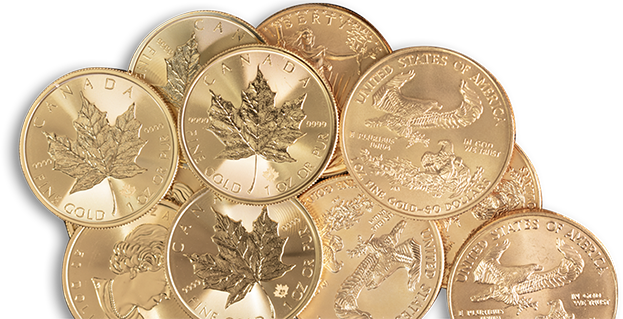
The Maple Leaf is the Mint’s flagship range and the reason most people know the name. The gold coin arrived in 1979, the silver and platinum versions followed in 1988, and a palladium coin has appeared intermittently since 2005, though it is not currently part of the range. Gold and silver are struck at 9999 fineness and platinum at 9995. Each coin is legal tender in Canada and carries a face value in Canadian dollars.
Gold is where the range runs widest. Alongside the standard one ounce coin, the Mint produces half, quarter, tenth and twentieth ounce pieces, plus one gram coins issued twenty-five to a sheet as the MapleGram25, which snap out individually. A twentieth of an ounce is among the smallest legal tender gold coins struck anywhere, and the gram coins take divisibility further still.
Silver has gone the other way. The one ounce coin remains the volume product, but the Mint now also strikes larger 9999 silver Maple Leafs at two, five and ten ounces, issued as Twin Maples, Grand Maple Leaf and Magnificent Maples. Silver coins also carry MintShield, a surface treatment introduced to reduce the white spotting that can develop on high purity silver over time.
Beyond the Maple Leaf, the Mint produces commemorative and collector issues that change from year to year, alongside numismatic coins and medals. Those sit outside the bullion range and are priced on design and mintage rather than metal content.
BullionStar stocks Gold and Silver Maple Leaf coins alongside the Mint’s bars. Browse the full range of gold coins and silver coins.

How to Identify a Genuine Maple Leaf
Maple Leafs carry more anti-counterfeiting engineering than almost any other bullion coin. The Mint groups it under the name Bullion DNA, and it combines two features you can see with a database you cannot.
The first is the radial lines: a pattern of fine lines machined across both faces of the coin to a tolerance measured in microns. They diffract light in a way that shifts as the coin is tilted, and because the machining tolerance is so tight, the effect is difficult to reproduce convincingly. A counterfeit will often get the lines approximately right and the light behaviour wrong.
The second is a security mark. Every die used to strike gold or silver Maple Leafs is laser micro-engraved with a textured maple leaf, fine enough to be visible only under magnification. It is struck into the coin rather than applied afterwards, so it cannot be added to a blank.
Both features have a start date, which matters when you are looking at an older coin. Gold Maple Leafs carry them from 2014 onwards and silver from 2015. A 2009 Silver Maple Leaf has neither, and that is not a warning sign, it simply predates the technology. Anything dated after those years should have both.
How Bullion DNA Verification Works
The database is where Bullion DNA differs from the systems other producers use, and the difference is worth understanding before relying on it.
Verification is a dealer procedure rather than a consumer one. The coin is placed into a specialised device, an application photographs it at high resolution, and the image is matched against the Mint’s encrypted records. Only approved Bullion DNA dealers hold the equipment. That is a robust check, but it is not one you can run yourself, which sets it apart from the PAMP Veriscan system, where any owner can scan a bar with a phone app. If you are buying privately, Bullion DNA offers you no reassurance at the point of sale.
In practice:
– Tilt the coin under a light and watch the radial lines. The effect should shift smoothly and evenly across both faces.
– Look for the micro-engraved maple leaf under magnification on any coin dated 2014 or later for gold, 2015 or later for silver.
– Weigh and measure it. A convincing copy of the design is usually wrong on weight, dimensions or both.
– Where any doubt remains, have it checked by a dealer, who can either run Bullion DNA verification or test the metal directly.
Our guides on how to test gold and how to test silver cover the physical methods in more detail.
Royal Canadian Mint Prices and Premiums
A Maple Leaf is priced from the live spot price of the metal it contains, plus a premium covering refining, striking, packaging and distribution. Spot moves continuously through the trading day, and the premium is the part that differs between mints.
The table below compares the cheapest 1 oz gold coin currently listed from each mint in our range, priced at the same moment at the time of writing. Fineness is given in the millesimal system, where 9999 means 99.99% pure gold, or 24 karat, and 916 means 91.6% gold, or 22 karat.
| 1 oz gold coin | Fineness | Premium over spot |
|---|---|---|
| Australian Gold Kangaroo (Perth Mint) | 9999 | 3.9% |
| Canadian Gold Maple Leaf (Royal Canadian Mint) | 9999 | 4.1% |
| UK Gold Britannia (Royal Mint) | 9999 | 4.1% |
| Austrian Gold Philharmonic (Austrian Mint) | 9999 | 4.3% |
| South African Krugerrand (Rand Refinery) | 916 | 4.4% |
| American Gold Buffalo (US Mint) | 9999 | 6.7% |
The Maple Leaf sits in the middle of that group, level with the Britannia, and within half a percentage point of everything except the Buffalo, which prices well above the field. For a coin with the Maple Leaf’s recognisability and security engineering, mid-pack is a reasonable place to be.
The Krugerrand row deserves a pause, because 916 fineness does not mean less gold. A Krugerrand weighs 33.93 grams against the Maple Leaf’s 31.1 grams, the difference being copper, added to make the coin harder and more resistant to wear. Both contain a full troy ounce of gold. What the lower fineness changes is not the gold content but the tax treatment, at least in Singapore. The Investment Precious Metals exemption requires gold of at least 99.5% fineness, so the Maple Leaf, the Britannia and the Philharmonic all qualify for GST exemption here, while the Krugerrand does not and is sold under the Gross Margin Scheme instead.
That is the practical answer to a question buyers ask often. On premium the two coins sit within a third of a percentage point of each other. On tax, for anyone buying in Singapore, they are not close at all.
Silver premiums work differently, because the same fabrication cost is a far larger share of a much cheaper metal, so a 1 oz Silver Maple Leaf carries a premium several times the gold coin’s in percentage terms. You can check today’s prices on our gold price today and silver price today pages, and current buy-back rates for every product on our sell gold and silver page.
Royal Canadian Mint Products Outside Canada
The Mint sells its own bullion directly, through boutiques, a call centre, an app and an online store, and it also supplies an authorised dealer network that takes in Canadian chartered banks and its own Bullion DNA dealers. Outside Canada that dealer network is how Maple Leafs reach most buyers, and it removes much of the shipping, taxation and storage friction of importing coins individually.
Maple Leafs qualify for GST exemption in Singapore under the Investment Precious Metals (IPM) scheme, so there is no sales tax applied at purchase. Singapore also levies no capital gains tax, so no Singapore tax arises on any gain when you sell. Tax residents of other countries should check their local rules, since a gain may still be taxable where you live.
Buying from an established dealer also means the coin has already been through professional verification, whether by Bullion DNA or another method, which is not a check a private buyer can perform.
Purchases made with BullionStar can be shipped internationally, stored securely in our Singapore vault, or collected from our Bullion Center. Metal left in the vault can also be sold back online at any time without being shipped anywhere first.
Frequently Asked Questions
Is the Royal Canadian Mint government owned?
Yes. The Royal Canadian Mint is a federal Crown corporation, wholly owned by the Government of Canada and operating as an agent of the Canadian monarch. It has its own board of directors, including the Master of the Mint, and reports to Parliament through the Department of Finance. It receives no government funding, and covers its costs commercially.
What purity are Gold Maple Leaf coins?
Gold Maple Leafs are 9999, or 99.99% pure gold. The coin launched in 1979 at 999 fineness and moved to 9999 in November 1982, which the Mint describes as the world’s first 99.99% pure gold bullion coin. Silver Maple Leafs are struck to the same 9999 standard and the platinum coin to 9995. The Mint has occasionally issued 99999 gold pieces, but only as special editions rather than as the standard annual bullion coin.
Where are Maple Leaf coins made?
All Royal Canadian Mint bullion coins and bars are produced at the Mint’s Ottawa facility on Sussex Drive, which also houses its gold and silver refinery. The Mint’s second plant, in Winnipeg, strikes Canada’s circulating coinage and coins for other countries rather than bullion.
What is Bullion DNA?
Bullion DNA is the Royal Canadian Mint’s anti-counterfeiting system, and it has three parts. Radial lines are machined across both faces of the coin to a tolerance measured in microns, producing a light-diffracting pattern; a textured maple leaf is laser micro-engraved into each production die, visible only under magnification; and both are recorded in the Mint’s encrypted database. Gold Maple Leafs carry it from 2014 onwards and silver from 2015. Verification is carried out by approved Bullion DNA dealers using a dedicated device, so it is not a check an owner can run at home.
Are Maple Leafs better than Krugerrands?
Neither is better outright. Both coins contain a full troy ounce of gold, but the Krugerrand is 916 fineness (22 karat) because copper is added for hardness, so the coin weighs more overall but holds the same gold. The difference that matters for a buyer in Singapore is tax, since the Maple Leaf qualifies for the Investment Precious Metals GST exemption and the Krugerrand does not.
Can I buy Royal Canadian Mint coins outside Canada?
Yes. The Mint sells its bullion directly and also supplies an authorised dealer network internationally, which is how most Maple Leafs reach buyers outside Canada. BullionStar stocks Gold and Silver Maple Leaf coins in Singapore, where they qualify for GST exemption as Investment Precious Metals, with international shipping, allocated vault storage, or collection from our Bullion Center.
Do Maple Leaf coins scratch easily?
More easily than lower-purity coins, yes. Gold and silver at 9999 are soft metals, and the Maple Leaf’s fine radial lines show handling marks more readily than a busier design would. Handle coins by the edge and keep them in their tubes or capsules. Marks do not affect bullion value, since a dealer prices by weight and purity rather than condition, though they matter if you are selling collector-grade coins. Milk spotting is a separate issue: small white marks that can appear on high-purity silver over time, which the Mint’s MintShield surface treatment was introduced to reduce.
Buying and Selling Royal Canadian Mint Bullion
The Royal Canadian Mint is a national mint whose business is really bullion. Four fifths of its revenue comes from precious metals rather than coinage, and the refinery that makes that possible has held London Good Delivery accreditation since the early twentieth century, in the same building that strikes the coins. Very few institutions in the world do both at that standard.
The Maple Leaf is the coin that made 9999 the industry benchmark, and the highest practical fineness used in mass produced bullion coins. It’s a range recognised anywhere in the world, and has more anti-counterfeiting engineering than almost any rival in Bullion DNA.
Ready to buy? Browse our full range of gold coins and silver coins, including the current Gold and Silver Maple Leaf issues, along with Royal Canadian Mint gold bars and silver bars. Bullion can be shipped internationally, held in allocated storage in our Singapore vault, or collected from our Bullion Center at 45 New Bridge Road. Live buy-back prices are published at all times on our sell gold and silver page, and metal held in the vault can be sold back online at any hour without being shipped anywhere first.
Subscribe to Gold University Articles
Copyright Information: BullionStar permits you to copy and publicize articles or information from the BullionStar Gold University provided that a link to the article's URL or to https://bullionstar.com is included in your introduction of the article or blog post together with the name BullionStar. The link must be target="_blank" without re="nofollow". All other rights are reserved. BullionStar reserves the right to withdraw the permission to copy content for any or all websites at any time.