 Contact
 Help




Swiss Gold Reserves: How Much Gold Does Switzerland Have?


Switzerland’s gold reserves stand at 1,040 tonnes, one of the largest official gold reserves in the world. The reserve belongs to the Swiss National Bank (SNB), and according to World Gold Council figures for the end of 2025, it ranks Switzerland seventh among the world’s gold holders. For a country of around nine million people, that is a remarkable amount. It works out at roughly 115 grams of gold for every Swiss resident, one of the highest levels per person anywhere.
Switzerland once held far more. Gold backed the Swiss franc by law until 2000, and the SNB held about 2,590 tonnes at the end of the 1990s. Over the following eight years it sold 1,550 tonnes, well over half the reserve. That decision still divides opinion. In 2014, a national referendum called “Save Our Swiss Gold” proposed banning further sales, bringing all the gold home, and requiring the SNB to hold at least 20% of its assets in gold. Swiss voters rejected it.
This guide sets out how much gold Switzerland has and where it is stored, how the reserve came to be halved, and what happened in the 2014 referendum. It also covers Switzerland’s wider role as the centre of the world’s gold refining industry, which is a separate story from the SNB’s own holdings.

Highlights
- Switzerland holds 1,040 tonnes of gold through the Swiss National Bank, the seventh-largest official gold reserve in the world according to World Gold Council figures for the end of 2025.
- The SNB stores about 70% of its gold in Switzerland, 20% at the Bank of England and 10% at the Bank of Canada, a split it first disclosed in 2013.
- The SNB sold 1,550 tonnes between 2000 and 2008, more than half of its reserve, after the Swiss franc’s legal link to gold was removed.
- Swiss voters rejected the 2014 Save Our Swiss Gold referendum, which would have required the SNB to hold at least 20% of its assets in gold.
How Much Gold Does Switzerland Have?
Switzerland’s gold reserves are held by the Swiss National Bank and total 1,040 tonnes. The World Gold Council puts the exact figure at 1,039.9 tonnes for the end of 2025, or about 33.4 million fine troy ounces. The SNB’s holdings have stayed the same since 2008, when it completed its last round of gold sales.
| Swiss gold reserves | Figure |
|---|---|
| Tonnes | 1,040 |
| Fine troy ounces (approx.) | 33.4 million |
| Value (SNB, end of 2025) | CHF 115.4 billion |
| Share of total reserves | 13.6% |
| World ranking | 7th |
| Gold per resident (approx.) | 115 grams |
Sources: Swiss National Bank; World Gold Council, end-2025 figures.
Unlike the US Treasury, which still values US gold reserves at a 1973 statutory price, the SNB values its gold at market prices. At the end of June 2026, gold was trading at CHF 104,812 per kilogram, which put the SNB’s reserve at about CHF 109 billion. As a result, the gold price has a direct effect on the SNB’s profits. In 2025, a 46% rise in the gold price in Swiss francs produced a valuation gain of CHF 36.3 billion on the SNB’s gold. In the first half of 2026, a lower gold price led to a valuation loss of CHF 6.4 billion.
Although the reserve is large, gold makes up only around 13.6% of Switzerland’s total reserves. That’s far below the 70% to 80% held by the US, Germany, Italy and France. The reason is not a shortage of gold but the size of the SNB’s other holdings. Since the 2008 financial crisis, the SNB has bought hundreds of billions of francs’ worth of foreign currencies and assets to stop the Swiss franc from rising too far, and those foreign currency reserves now dwarf its gold. To see how Switzerland’s gold reserves compare to other countries, see our guide to gold reserves by country.
Where Is Switzerland’s Gold Stored?
For decades, the SNB refused to say where its gold was kept, citing security. That changed in April 2013. As pressure grew from the Save Our Swiss Gold initiative, SNB Chairman Thomas Jordan disclosed the split for the first time:
| Location | Share | Approximate tonnes |
|---|---|---|
| Switzerland | about 70% | about 730 |
| Bank of England, London | about 20% | about 210 |
| Bank of Canada, Ottawa | about 10% | about 105 |
Source: Swiss National Bank. Tonnages are approximate, based on 1,040 tonnes in total.
The SNB says spreading its gold across several locations makes sure it can reach its reserves in a crisis. When it made the disclosure, it said each storage country had been chosen for “adequate regional diversification and good market access”, and had to be politically and economically stable and guarantee the legal immunity of central bank assets. London is the centre of the global wholesale gold market, and the Bank of England gold vaults hold gold for dozens of central banks. The SNB has used its London gold to settle trades in the past. When it sold gold in the early 2000s, much of the metal was delivered from its holdings there.
The SNB’s Vault in Bern
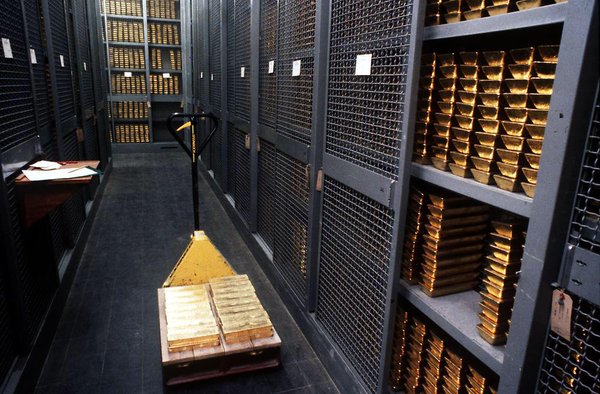
The SNB has never confirmed where its gold in Switzerland is kept. Swiss media have long reported that most of it sits in the vaults beneath the SNB’s headquarters on the Bundesplatz in Bern, and photographs of those vaults have been published. The building then went through a long renovation from 2015. The SNB has not said whether the gold stayed in Bern during that time.
Gold Stored for Other Central Banks
The vaults in Bern also hold gold belonging to other central banks. The Bank for International Settlements, the central bank for central banks, has no gold vaults of its own and uses the SNB’s vaults in Bern for its gold services. Several central banks have disclosed holdings there:
| Central bank | Gold held in Switzerland | Disclosed |
|---|---|---|
| Sveriges Riksbank (Sweden) | 2.8 tonnes (2.2% of its gold) | October 2013 |
| Bank of Finland | 7% of its gold | October 2013 |
| Banca d’Italia | A “smaller” share, held through the BIS | 2014 |
| Oesterreichische Nationalbank (Austria) | Target of 20% of its gold by 2020, up from 3% | May 2015 |
Sources: the central banks listed.
Bars, Coins and Gold Lending
According to the SNB, its gold is held mainly as bars, with a smaller amount in coins. It does not publish any further detail on the bars or coins. The SNB lent out some of its gold to financial institutions in the 2000s and early 2010s, but it told BullionStar in 2016 that it has had no gold lending outstanding since 2012. That means all of its 1,040 tonnes are held as physical gold, rather than partly as claims on borrowers.
History of Swiss Gold Reserves
For most of its history, the Swiss franc was one of the world’s primary gold-backed currencies. Switzerland’s 20-franc gold coins, the Vreneli, were minted between 1897 and 1949 and are still traded widely today as the Swiss 20 Franc gold coin. Long after other countries cut their currencies’ ties to gold, Swiss law still required the SNB to back a share of the banknotes in circulation with gold. The franc also kept an official gold parity of CHF 4,595 per kilogram into the late 1990s, roughly a third of the market price at the time. By then, the SNB held about 2,590 tonnes of gold, the fourth-largest held by any country.
Ending the Gold Link
In the late 1990s, Switzerland decided this was no longer needed. In October 1997, an expert group concluded that 1,300 tonnes of the SNB’s gold, half of the reserve, were not required for monetary purposes. Swiss voters approved a new federal constitution in April 1999 that cut the franc’s legal link to gold. A new currency law then came into force in May 2000, and the SNB began selling gold the following day.
Selling Half the Reserve
The SNB sold its gold in two rounds:
| Period | Tonnes sold | Holdings afterwards |
|---|---|---|
| May 2000 to March 2005 | 1,300 | 1,290 |
| 2007 to 2008 | 250 | 1,040 |
| Total | 1,550 |
Sources: Swiss National Bank; SNB Chairman Philipp Hildebrand, May 2005.
The first round was coordinated with other European central banks under the 1999 Central Bank Gold Agreement, which capped how much each could sell per year. The SNB sold 220 tonnes through the Bank for International Settlements, 730 tonnes directly on the spot market, and 350 tonnes through option programmes. It finished on 30 March 2005. The sales raised CHF 21.1 billion at an average price of US$351.40 an ounce. Two-thirds of the money went to Switzerland’s 26 cantons and one-third to the federal government, after voters rejected a plan in 2002 to use it for a new solidarity foundation.
In June 2007, the SNB announced a further 250 tonnes of sales to rebalance its reserves between gold and foreign currencies. These were completed in 2008, leaving the 1,040 tonnes the SNB still holds today.
In hindsight, the timing was poor. The SNB sold most of its gold at between US$250 and US$450 an ounce, close to the bottom of a two-decade bear market. At today’s prices, the 1,550 tonnes it sold would be worth far more than the CHF 21 billion or so that the first round raised. That gap, together with Switzerland’s long tradition of gold-backed money, helped fuel the 2014 referendum.
The Save Our Swiss Gold Referendum
Many Swiss people were unhappy that half of the national gold reserve had been sold at what proved to be historically low prices. In the early 2010s, three politicians from the Swiss People’s Party, including National Councillor Luzi Stamm, launched a popular initiative called “Save Our Swiss Gold”. It gathered the 100,000 signatures needed to force a national vote. The initiative would have written three rules into the Swiss constitution:
– The SNB would never again be allowed to sell any of its gold.
– All Swiss gold held abroad, at the Bank of England and the Bank of Canada, would have to be brought back to Switzerland.
– At least 20% of the SNB’s assets would have to be held in gold.
The third rule was the most significant. In 2014, gold made up less than 8% of the SNB’s assets. Meeting the 20% minimum would have meant buying an estimated 1,500 tonnes of gold, worth around CHF 70 billion, over five years. That would have more than doubled the reserve, taking it almost back to its level before the sales of 2000 to 2008.
What Happened to the Campaign
The Swiss government and the SNB both opposed the initiative, and none of the major political parties backed it. SNB Chairman Thomas Jordan warned that a gold floor would tie the bank’s hands at a time when it was defending a ceiling on the Swiss franc’s value against the euro. Gold could not be sold, so as the SNB’s balance sheet grew, it would have had to keep buying gold that it could never use. Supporters argued that gold would hold its value across generations in a way that paper currencies issued by heavily indebted governments would not.
On 30 November 2014, Swiss voters rejected the initiative by about 77% to 23%. Six weeks later, on 15 January 2015, the SNB abruptly abandoned its cap on the franc, the policy it had warned the initiative would undermine. The SNB’s gold holdings have stayed at 1,040 tonnes ever since. The referendum also made a lasting difference to transparency: it was during the campaign that the SNB first revealed where its gold is stored.
Switzerland’s Role in the Global Gold Market
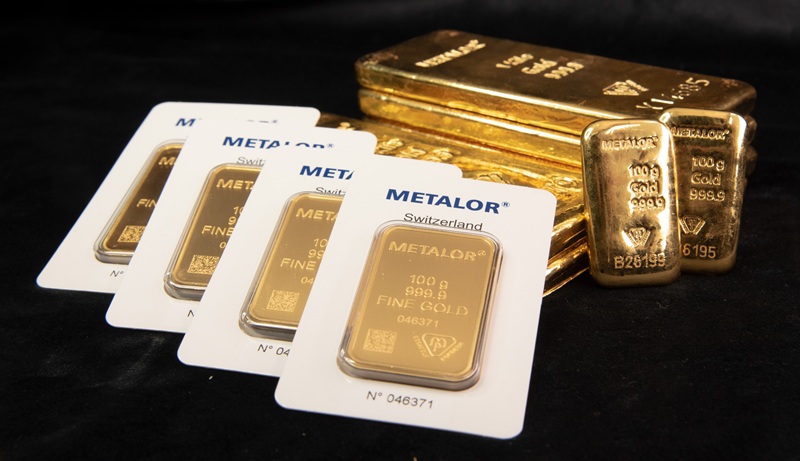
Switzerland’s importance in gold goes far beyond the SNB’s reserves. The country is the centre of the world’s gold refining industry. Four of the world’s largest refiners are based there: PAMP, Valcambi, Argor-Heraeus and Metalor. Three of them sit within a few kilometres of each other in the canton of Ticino, close to the Italian border. Three of the seven referees that test and certify gold for the LBMA’s Good Delivery system are also Swiss.
According to the Swiss State Secretariat for Economic Affairs, Swiss refineries produced about a third of the world’s refined gold in 2023. Most of the gold passing through the country is not mined there at all. In 2023, Switzerland imported 2,372 tonnes of gold and exported 1,564 tonnes, much of it as mine output (doré) and large wholesale bars, which Swiss refiners turned into other forms. A typical flow is 400-ounce bars from London being melted down and recast into the 1-kilogram bars favoured by buyers in China and India, which were Switzerland’s two largest gold customers that year.
Although Swiss refiners handle huge volumes of gold, almost none of it belongs to Switzerland. The SNB’s 1,040 tonnes are a separate national reserve. The refining industry processes gold on behalf of mining companies, banks, investors and other central banks. For more on the companies behind Swiss bars, see our guide to precious metal refiners.
Frequently Asked Questions
How much gold does Switzerland have?
Switzerland has 1,040 tonnes of gold, held by the Swiss National Bank. That makes it the seventh-largest official gold holder in the world, according to World Gold Council figures for the end of 2025. The SNB’s gold holdings have not changed since 2008.
Where are Switzerland’s gold reserves stored?
According to the Swiss National Bank, about 70% of Switzerland’s gold is stored in Switzerland, about 20% at the Bank of England in London and about 10% at the Bank of Canada. The SNB has never confirmed where the gold kept in Switzerland is held, but it is widely believed to be in the vaults beneath its headquarters in Bern.
Is the Swiss franc backed by gold?
No. The Swiss franc’s legal link to gold ended when voters approved a new federal constitution in April 1999, followed by a new currency law in May 2000. Until then, Switzerland was one of the last countries to back its currency with gold by law. The SNB still holds 1,040 tonnes of gold as part of its reserves, but francs cannot be exchanged for gold.
Why did Switzerland sell its gold?
Once the franc’s gold link was removed, the Swiss National Bank decided that half of its 2,590 tonnes of gold was no longer needed for monetary purposes. It sold 1,300 tonnes between 2000 and 2005, raising CHF 21.1 billion for the federal government and the cantons. It then sold another 250 tonnes in 2007 and 2008 to rebalance its reserves.
What was the Save Our Swiss Gold referendum?
Save Our Swiss Gold was a 2014 popular initiative that would have banned the Swiss National Bank from selling gold, required all Swiss gold to be stored in Switzerland, and obliged the SNB to hold at least 20% of its assets in gold. Swiss voters rejected it by about 77% to 23% on 30 November 2014.
Does Switzerland refine most of the world’s gold?
Switzerland is the world’s largest gold refining centre, producing about a third of the world’s refined gold in 2023. Major refiners such as PAMP, Valcambi, Argor-Heraeus and Metalor are based there. This gold is processed for mining companies, banks and investors, and it is separate from the Swiss National Bank’s own reserves.
Buying Swiss Gold
Switzerland’s gold story shows both sides of how governments treat gold. The country that once required its currency to be backed by gold sold half its reserve near the bottom of the market. Its voters then turned down a plan to rebuild it, and today its gold makes up a far smaller share of its reserves than Germany’s, Italy’s or France’s. Yet the SNB still holds 1,040 tonnes, has not sold an ounce since 2008, and has kept a large part of it at home. Even a central bank that cut its currency’s link to gold has chosen to keep a lot of it.
For individual investors, Switzerland’s influence is felt mainly through its refiners. Bars from Switzerland’s leading refineries are recognised and trusted by dealers worldwide, which makes them easy to buy and sell anywhere. BullionStar stocks a wide range of gold bars from Swiss refiners such as PAMP, Valcambi, Argor-Heraeus and Metalor, from 1-gram bars up to 1-kilogram bars, as well as the classic Swiss 20 Franc Vreneli gold coin.
Unlike the SNB, which keeps part of its gold abroad and has never said exactly where the rest is held, BullionStar customers know exactly where their gold is. Bullion bought from BullionStar can be stored in fully allocated, insured vault storage at Le Freeport in Singapore. There, customers can view photos of their own bars and visit the vault in person to inspect them.
Subscribe to Gold University Articles
Copyright Information: BullionStar permits you to copy and publicize articles or information from the BullionStar Gold University provided that a link to the article's URL or to https://bullionstar.com is included in your introduction of the article or blog post together with the name BullionStar. The link must be target="_blank" without re="nofollow". All other rights are reserved. BullionStar reserves the right to withdraw the permission to copy content for any or all websites at any time.