 Contact
 Help





World Gold Council (WGC)


The World Gold Council (WGC) is the market development organisation for the gold industry. Its members are 29 of the world’s leading gold mining and royalty companies, and its job is to increase demand for gold: from investors, central banks and jewellery buyers, and in the wider financial system. Founded in 1987 and headquartered in London, it also has operations in the United States, India, China, Singapore, Japan and the UAE.
Most people know the WGC through its research. Its quarterly Gold Demand Trends report and its tables of central bank gold reserves are among the most quoted figures in the gold market, cited by journalists, analysts and dealers alike. Far fewer know that the WGC is also a major gold fund business. A WGC subsidiary sponsors SPDR Gold Shares (GLD), the world’s largest gold ETF, and the fees from that fund now dwarf the dues its mining members pay.
That combination is worth understanding before relying on the WGC’s numbers. It is an industry body, funded almost entirely by gold investment products it helped create, and its research is written to support demand for gold. That doesn’t make its data wrong, and much of it is the best available. But it is an advocate rather than a neutral statistics agency, and a growing share of its work is focused on paper and digital forms of gold rather than metal in the hands of its owners.
This guide covers what the WGC is, how it is run and funded, what it publishes and how to read it, its role in gold ETFs, and its latest plans for digital gold. It sits alongside our guides to the London Bullion Market Association, the London Platinum and Palladium Market and COMEX.
Highlights
- The World Gold Council (WGC) is the market development organisation for the gold mining industry. It was founded in 1987, is based in London and represents 29 mining, royalty and streaming companies.
- Almost all of the WGC’s income comes from sponsor fees on the SPDR Gold Shares (GLD) and SPDR Gold MiniShares (GLDM) ETFs. Dues from its mining members are now a very small share.
- Its quarterly Gold Demand Trends report is the most widely quoted source of gold market data, compiled with Metals Focus through a joint venture.
- A large part of the WGC’s central bank buying figures is an estimate of unreported purchases rather than gold that central banks have declared.
- The WGC created GLD with State Street in 2004. It is now developing digital gold products for banks and institutions through its Gold247 programme.
What Is the World Gold Council?
The World Gold Council is a membership association set up by the gold mining industry to promote gold. Legally it is a Swiss association, registered in Geneva, but it is run from London. Its stated aim is to strengthen gold’s role as a strategic asset, through research, through working with central banks, regulators and the financial industry, and through creating new ways for people to buy and hold gold. It does not mine, refine or sell gold to the public. Its job is to create demand for the gold its members produce.
Members and Leadership
The WGC’s 29 members are gold mining, royalty and streaming companies. They include the industry’s largest producers, among them Newmont, Barrick, Agnico Eagle, AngloGold Ashanti, Gold Fields and Kinross, and China’s Zijin Mining, Shandong Gold and China National Gold. Each member company has a seat on the WGC board.
Since 29 September 2026 the board has been chaired by Paul Brink, chief executive of the royalty company Franco-Nevada. Day-to-day leadership sits with David Tait, chief executive since 2018, and a team of around 60 permanent staff.
How the WGC Is Funded
The WGC is usually described as being funded by the mining industry. Its accounts tell a different story. Members pay dues based on the ounces they produce, but those dues are now a very small share of its income. Almost all of its revenue comes from sponsor fees on two US gold ETFs, SPDR Gold Shares (GLD) and SPDR Gold MiniShares (GLDM), which WGC subsidiaries sponsor.
An ETF’s sponsor is the company that sets up the fund and is responsible for running it. In return, it charges a sponsor fee, a fixed annual percentage of the fund’s assets. For GLD the fee is 0.40% a year, calculated on the fund’s value every day and paid monthly. GLD holds no cash, so the fee is paid by selling a small amount of the fund’s gold, which slowly reduces the gold behind each share over time. Out of that fee, the sponsor pays the fund’s running costs: the banks that store the gold, the trustee that administers it, and the marketing agent that promotes it. Whatever is left belongs to the sponsor, which in GLD’s case is a WGC subsidiary. GLDM works the same way, but at 0.10% a year, a quarter of GLD’s rate.
| WGC revenue | 2024 | 2025 |
|---|---|---|
| GLD sponsor fees | US$262.0m | US$427.8m |
| GLDM sponsor fees | US$7.9m | US$16.7m |
| Members’ dues | US$3.5m | US$3.2m |
| Other income | US$1.0m | US$0.1m |
| Total revenue | US$274.4m | US$447.8m |
In 2025, ETF fees made up 99% of the WGC’s revenue, and members’ dues less than 1%. The WGC’s income therefore rises and falls with the gold price and with how much gold investors hold through the two funds. Most of what remains after the funds’ running costs goes on market development, at a cost of US$297.6 million in 2025. The WGC also holds gold itself: at the end of 2025, its gold holdings were valued at US$879 million, including just under 204,000 ounces of vaulted gold.
That funding model has changed considerably over time. When Ronan Manly looked at the WGC’s funding model in 2015, GLD fees had made up 55% to 70% of its revenue between 2011 and 2013, and member dues still ran to tens of millions of dollars a year. Today the industry body for gold miners is, in financial terms, mainly an ETF sponsor.
A Short History
The WGC was founded in 1987 by a group of leading mining companies, including Newmont, Consolidated Gold Fields and American Barrick, to promote gold demand at a time when the industry was expanding rapidly. It was registered in Geneva and moved its operations to London the following year.
For its first two decades, its work centred on jewellery marketing and promoting gold to investors and central banks. The turning point came in November 2004, when it launched SPDR Gold Shares with State Street. GLD went on to become the world’s largest gold ETF and, over time, the WGC’s main source of income. A smaller, lower-cost sister fund, GLDM, followed in 2018.
In 2019 the WGC introduced its Responsible Gold Mining Principles, which member companies must follow. More recently, its focus has turned to market infrastructure and digital gold, covered later in this guide.

What the WGC Publishes and How to Read It
The WGC’s research is its public face, and for many investors it is the only part of the organisation they ever see. Most of it is published free on its Goldhub data site and is quoted every quarter by the financial press. It is detailed, consistent and often the best data available. But it comes from an organisation whose job is to promote gold, and it is worth knowing how the numbers are put together before you rely on them.
Gold Demand Trends
The WGC’s flagship report is Gold Demand Trends, published quarterly and in a full-year edition each January. It breaks global gold demand into jewellery, technology, investment (bars, coins and ETFs) and central bank buying, and sets that against supply from mining and recycling.
| Gold demand and supply, full year 2025 | Tonnes |
|---|---|
| Jewellery | 1,542 |
| Bar and coin investment | 1,374 |
| Gold ETFs (net inflows) | 801 |
| Central banks (net purchases) | 863 |
| Mine production | 3,672 |
| Recycled gold | 1,404 |
The underlying figures are compiled by Metals Focus, a London precious metals consultancy, through Metals Focus Data Ltd, a joint venture it has run with the WGC since 2013. That makes the WGC’s numbers closer to an in-house dataset than an independent source, though Metals Focus is a respected research house in its own right.
Central Bank Gold Data
The WGC is the most widely quoted source on central bank gold buying. It publishes two different kinds of figures, and it pays to know which one you are looking at.
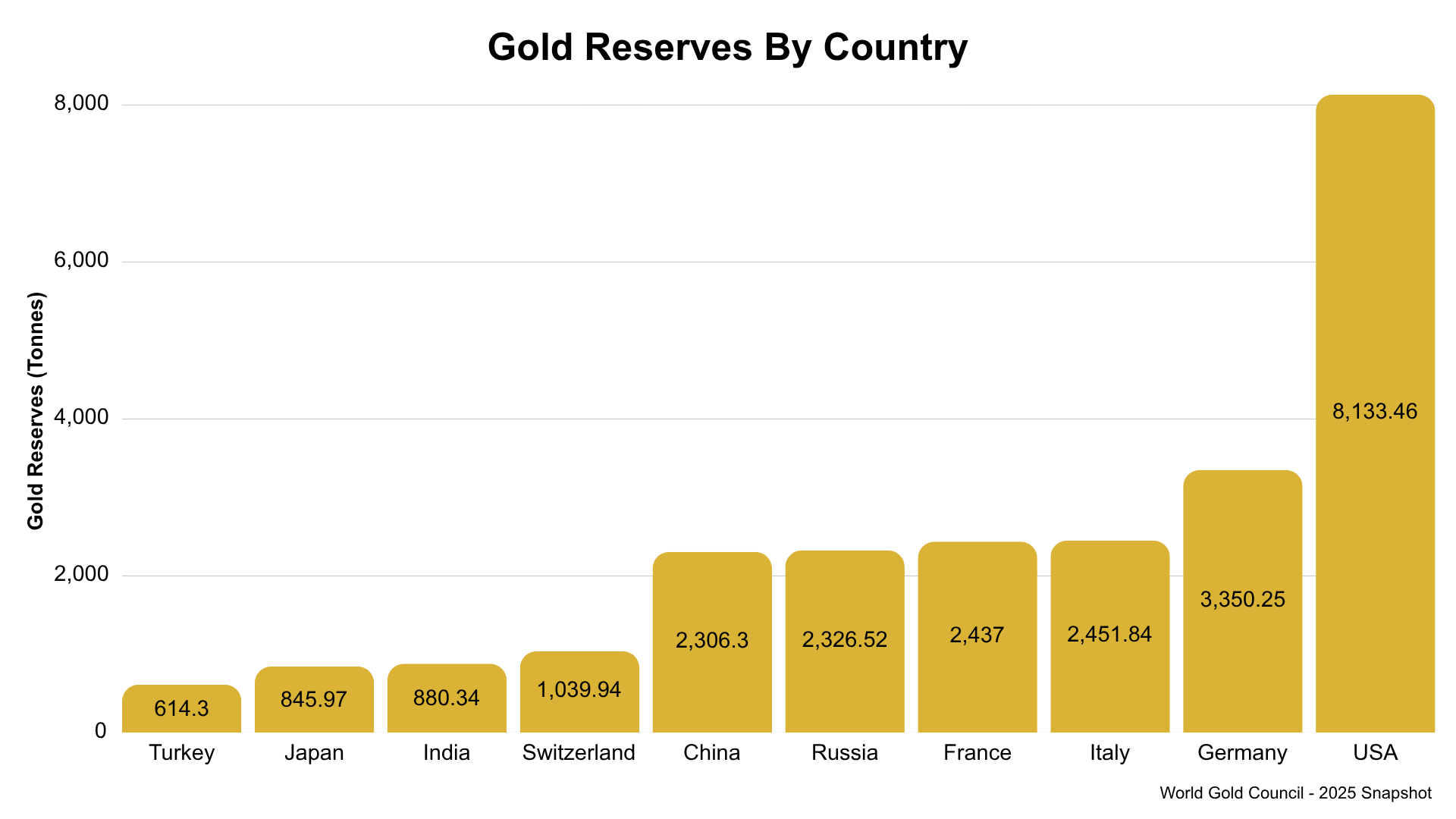
The first is official reserves: the gold holdings that central banks report each month, mostly through the International Monetary Fund. These figures are the basis for country rankings such as our Gold Reserves by Country guide.
The second is the WGC’s estimate of total central bank demand, which includes purchases no central bank has reported. In 2025, central banks bought 863 tonnes of gold by this measure, but 57% of it was unreported. In other words, it was estimated by Metals Focus from trade flows and other market evidence rather than declared by any central bank. The estimate may well be right, and central banks clearly have reasons to buy quietly. But headlines about record central bank buying are often built mostly on figures that no central bank has confirmed.
Reading WGC Data with Care
The WGC’s figures are best treated as a well-informed industry view rather than a neutral official statistic. Three points are worth keeping in mind.
First, the framing favours gold. Reports emphasise demand records and new buyers, and a strong quarter for gold is more likely to make the WGC’s headlines than a weak one.
Second, some of the most important figures are estimates. That applies to unreported central bank buying, and also to the “over-the-counter and other” flows the WGC uses to reconcile demand with supply, which can swing by hundreds of tonnes from one year to the next.
Third, different sources can tell a very different story. BullionStar has long argued that the WGC’s consumer-based measure of Chinese demand understates how much gold actually flows into China, judged by withdrawals from the Shanghai Gold Exchange vaults. Our guide to the Chinese gold market explains the difference.
The WGC, Gold ETFs and Digital Gold
The WGC’s research gets the headlines, but its real influence on the gold market comes from the products it has built. It created the first major US gold ETF, which became the largest in the world. It is now trying to turn gold into a digital asset that can be traded and pledged as easily as a bond. Both reflect the same strategy: making gold easier to buy, hold and trade within the financial system, rather than as physical metal held by its owner.
The WGC and GLD
SPDR Gold Shares (GLD) launched in November 2004, created by the WGC with State Street. It made gold investment as simple as buying a share, and it changed the market. GLD holds around 1,050 tonnes of gold, more than the official reserves of all but a handful of countries. It remains the world’s largest gold ETF.
The structure is straightforward on paper. GLD’s gold is held in London vaults by its custodians, HSBC and JPMorgan, and each share represents a fraction of that gold. But a GLD shareholder owns a share in a trust, not gold. Shares cannot be exchanged for metal except in very large blocks by a small group of authorised participants, which are mostly bullion banks. A shareholder has no claim on any specific bar, and every year a small part of the fund’s gold is sold to pay the sponsor fee. How GLD works, and how it differs from owning gold directly, is covered in our guide to gold ETFs.
For the WGC, GLD has become far more than a product. As the funding section above shows, it now provides almost all of the WGC’s income. That gives the gold industry’s main promotional body a direct financial interest in investors holding gold through an ETF rather than as physical metal.
Gold247 and the Push for Digital Gold
The WGC’s newest initiative, launched in 2022, is Gold247. It is a programme to modernise the gold market’s infrastructure, and it has three main parts.
The first is Gold Bar Integrity, a database built with the LBMA that records gold bars on a distributed ledger. The aim is to track each bar’s origin and ownership through the supply chain. The WGC holds a stake in aXedras, the Swiss technology company behind the system.
The second, announced in September 2025, is a “wholesale digital gold” framework built around a new legal instrument called the Pooled Gold Interest. A Pooled Gold Interest is a fractional share in a pool of physical gold held in approved vaults. It is designed to combine the security of allocated gold with the ease of trading unallocated gold. It can be transferred electronically, so banks and traders can use gold as collateral and margin in the same way as cash or government bonds.
The third is a “Standard Gold Unit”, a proposed common standard for tokenised gold that would allow fractional ownership down to a single gram.
All three are aimed at institutions, not private investors, and none has yet been widely adopted. The direction is clear, though. The WGC’s vision for gold’s future is a digital claim moving between banks, much as the WGC built GLD to make gold trade like a share. Whatever the merits for the wholesale market, it is a long way from what most people mean by owning gold.
Frequently Asked Questions
What is the World Gold Council?
The World Gold Council (WGC) is the market development organisation for the gold mining industry. Founded in 1987 and based in London, it represents 29 gold mining, royalty and streaming companies. Its aim is to increase demand for gold through research, policy work with central banks and regulators, and new gold investment products such as SPDR Gold Shares (GLD).
Who funds the World Gold Council?
Almost all of the WGC’s income comes from sponsor fees on two US gold ETFs, SPDR Gold Shares (GLD) and SPDR Gold MiniShares (GLDM), which WGC subsidiaries sponsor. In 2025 those fees came to US$444.5 million, 99% of its revenue. Dues from its mining members contributed US$3.2 million, less than 1%.
What is Gold Demand Trends?
Gold Demand Trends is the WGC’s quarterly report on global gold supply and demand. It breaks demand into jewellery, technology, investment and central bank buying, and sets it against mine production and recycling. The underlying data comes from Metals Focus through a joint venture with the WGC. It is the most widely quoted source of gold market statistics.
Is World Gold Council data reliable?
WGC data is detailed and widely used, but it is not independent. The WGC is funded by gold ETF fees and its job is to promote gold. Several key figures are estimates rather than reported data. In 2025, 57% of its central bank buying figure was unreported purchases estimated by Metals Focus. It is best treated as a well-informed industry view.
Does the World Gold Council sell gold?
No. The WGC does not sell gold bars or coins to the public. It helps create gold investment products with partners. The best known are the SPDR Gold Shares (GLD) and SPDR Gold MiniShares (GLDM) ETFs, which give investors exposure to the gold price through shares rather than physical ownership of metal.
What is the WGC’s relationship with GLD?
The WGC created SPDR Gold Shares (GLD) with State Street in 2004, and a WGC subsidiary, World Gold Trust Services, is the fund’s sponsor. The sponsor charges an annual fee of 0.40% of the fund’s assets, paid by selling some of the fund’s gold. Those fees provide almost all of the WGC’s income.
From Gold Data to Gold Ownership
The WGC’s data tells a consistent story. Central banks have bought more than 850 tonnes of gold a year in recent years, much of it into vaults they control directly rather than through any fund or account. Whatever view you take of the WGC’s estimates, the institutions that think hardest about counterparty risk have chosen to hold physical metal. That is the lesson worth taking from the WGC’s research, more than the ETF and digital products it promotes.
For private investors, the closest equivalent is to own gold outright. BullionStar sells investment-grade gold bars and coins from LBMA-accredited refiners and leading mints, which can be shipped, collected from our Bullion Center or stored in BullionStar’s vaults in Singapore. Stored gold is fully allocated and held in your name, with every bar identified by serial number, and there is no fund, no sponsor fee and no counterparty between you and your metal.
Subscribe to Gold University Articles
Copyright Information: BullionStar permits you to copy and publicize articles or information from the BullionStar Gold University provided that a link to the article's URL or to https://bullionstar.com is included in your introduction of the article or blog post together with the name BullionStar. The link must be target="_blank" without re="nofollow". All other rights are reserved. BullionStar reserves the right to withdraw the permission to copy content for any or all websites at any time.