 Contact
 Help
Help






In Gold We Trust 2026: Key Takeaways for Gold Investors

 BullionStar
 0 Comments



Following gold’s recent record-breaking run, the 2026 ‘In Gold We Trust’ report provides a comprehensive overview of the gold market in 2026. Co-authored by Ronald-Peter Stöferle and Mark J. Valek, we take a look at some of the key takeaways for gold investors.

Gold’s Watershed Year
2025 was a watershed year for gold, achieving a 64.4% return, its strongest performance since 1979. Setting 51 all-time highs in 2025, it then pushed even higher in 2026, scoring a new USD peak of USD 5,595 per ounce in January 2026. Gold ceased to be a side-allocation, and became a headline asset, garnering attention from investors worldwide.
A 27% drawdown in March led to claims the metal had failed in its role as a safe haven, but those who have followed gold closely will recognise these patterns. As the report puts it, “during periods of acute financial stress, gold is sold not in spite of, but because of its high liquidity.” When markets experience a shock (such as the US-Iran conflict) traders sell their liquid assets to offset losses elsewhere. Gold fell 29% in 2008 and 12% in 2020 in the early stages of those crises; in both cases the metal went on to set fresh highs within 12–18 months.
Investment demand surged 84% yoy in 2025 to 2,175 tonnes, with bars and coins accounting for 1,374 tonnes. Gold is flowing east with India, China and the Middle East moving away from jewellery to coins and bars. March 2026 saw the largest-ever monthly outflow from gold ETFs globally (84.8 tonnes) yet Asian ETFs recorded their strongest quarter on record, absorbing the Western selling.
Ultimately, trust remains the core driver for the gold price in the eyes of Stöferle and Valek. “The collapse of institutional trust — in governments, central banks, and the fiat money system itself — has become the central driving force behind the price of gold." Physical gold continues to provide investors a way to protect against that erosion of trust, with a global asset that provides zero counterparty risk.

“Back to the Monetary Future" — The Report’s Core Thesis
The 2026 report is titled ‘Back to the Monetary Future’, a nod to the classic movie and a reminder that the future of money lies in its past. The monetary turning points of 1971 (the Nixon shock), 2008 (the GFC) and 2020 (the COVID monetary response) acted as tectonic shifts for the global economy, and continue to set today’s market dynamics.
Belief in fiat is falling each year, and it’s easy to see why. The US dollar has lost 85.3% of its purchasing power against gold since the first IGWT report in May 2007; the euro has lost 87.4% over the same period. This continual fiat depreciation is the silent default of monetary trust.
Inflation expectations have already reversed over the last few months. The 28 February 2026 US and Israeli strike on Iran sent Brent crude above USD 110 a barrel and, per the IEA, disrupted around 20% of seaborne oil trade, feeding directly through supply chains into headline inflation. New Federal Reserve Chairman Kevin Warsh is caught between rising inflation, and a President demanding rate cuts and a weaker US dollar.
America’s political and economic hegemony is showing real cracks, and the era of the petrodollar could become the era of the ‘petrogold’ as more countries move away from the US dollar. The US dollar’s share of global FX reserves has already dropped from 66% in 2006 to 57% in 2026. The freezing of Russian FX reserves in 2022 is cited as the paradigm shift, revealing the potential for the dollar to be weaponised. As Goldman Sachs’s Jeff Currie puts it in the report: “US dollar recycling is increasingly becoming gold recycling."

For now it remains unclear how big a role gold will play in whatever new monetary system emerges – whether it remains a reserve asset, or one actively used in the settlement of trade. Whatever its end use, those who own gold will be better positioned than those who don’t. Every dollar held in fiat is a short position on monetary discipline.
The Central Bank Bid Is Not Going Away
No discussion of the gold market in 2026 would be complete without mention of central bank demand, which has been a key gold price driver since 2020.
2025 saw 863 tonnes of net central bank purchases, following three consecutive years above 1,000 tonnes. To put that in context, the 2010–2021 average was 473 tonnes a year; the 2022–2025 average is 1,018 tonnes, more than double. Poland, Kazakhstan, Azerbaijan, Brazil, China, Türkiye and the Czech Republic were the largest buyers in 2025, with China continuing its steady accumulation, the report records 16 consecutive months of Chinese purchases as of early 2026.
In May 2026, Goldman Sachs revealed that even those headline figures may have understated the true scale of buying. Analysts Lina Thomas and Daan Struyven discovered that since August 2025, UK trade data had been systematically failing to capture gold leaving London’s vault network, meaning Goldman’s central bank nowcast had been undercounting purchases for roughly eight months. The bank revised its March 2026 estimate upward by more than 70%, from around 29 tonnes to roughly 50 tonnes, and now projects full-year 2026 central bank buying of approximately 720 tonnes. The correction did not reflect new behaviour, it reflected better measurement of behaviour that was already happening.
The institutional version of the trust repricing is just as stark. Gold’s share of global FX reserves has now risen to 26.6%, while the US dollar’s share excluding gold has fallen to 56.9% — its lowest level in roughly thirty years. The World Gold Council’s 2025 survey reports that 95% of central banks expect global gold reserves to rise, and not a single bank surveyed expects them to fall. As Adam Glapinski, Governor of the National Bank of Poland, has framed it: “Gold is the only safe investment for state reserves."

With central banks continuing to buy physical gold themselves, the message for investors is consistent. Holding allocated bars and coins in a vault outside the banking system is the same logic, just on a smaller scale.
Debt, Deficits and Ferguson’s Law
The fiscal backdrop the report describes is the structural reason central banks are buying gold, and the most reliable case for individual investors to do the same. On 17 March 2026, US federal debt crossed USD 39 trillion, with a debt-to-GDP ratio above 120%. As we reported earlier this month, global debt hit a record USD 353 trillion.
The trajectory is just as concerning as the level. The US fiscal year 2025 deficit closed at USD 1.8 trillion, or 5.8% of GDP, well above the long-run average of 3.8%. The report’s framing is blunt: “the risk-free investment is increasingly mutating into a yield-free risk investment."
The single cleanest signal that the United States has crossed into fiscal dominance is Ferguson’s Law. Historian Niall Ferguson’s rule of thumb is that a hegemon loses its dominant position once its interest payments exceed its defence spending. That threshold has now been breached in the US for the first time since the early Cold War. Once it breaks, it tends to stay broken.
The Federal Reserve formally ended quantitative tightening on 1 December 2025, but its balance sheet has expanded by roughly USD 175 billion in the months since, what Stöferle and Valek call a “silent QE." Treasury Secretary Scott Bessent made the underlying intention explicit in February 2025: “We’re going to monetize the asset side of the US balance sheet for the American people." That asset side includes 8,133 tonnes of gold, still booked at the statutory price of USD 42.22 an ounce – around USD 11 billion. At market value the holding is worth closer to USD 1.2 trillion, roughly 3% of national debt.
With debt this high and deficits this entrenched, real interest rates have to remain negative for the system to function, and negative real rates are the single most reliable backdrop gold has ever had. Private investors who already own physical bullion are positioned identically to the US Treasury itself.
The Western Investor Has Been Asleep
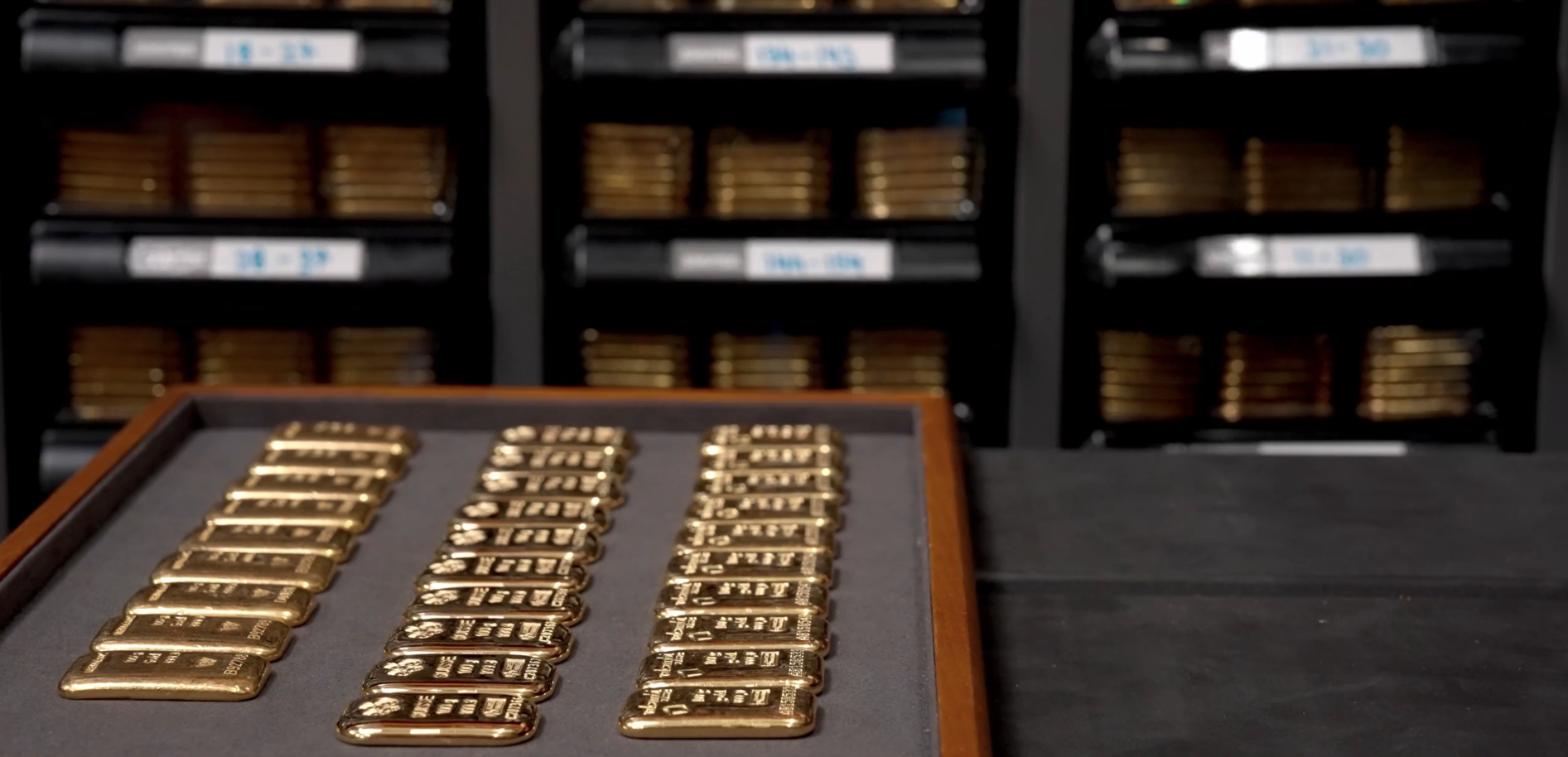
For all the central bank buying and macro shifts, the most striking statistic in the report may be how little gold private investors actually hold. Today’s private gold allocation is just 2.7% of global financial assets, well below the 1980 peak of 8.3%. Returning to that peak would require tripling current allocations. The authors describe the current market not as crowded, but as “a party where the first guests are just starting to arrive."
The institutional version of the picture is starker. JPMorgan’s 2026 Global Family Office Report found that 72% of family offices have zero exposure to gold. Gold ETFs make up just 0.17% of US retail portfolios. The report’s own backtest of an optimal portfolio over 1970–2024 puts the right gold allocation at 14–20% depending on risk tolerance, multiples above where the typical Western investor actually sits.
Why, then, are investors still so underexposed? The report calls it the “hedging paradox": geopolitics is consistently named the single most-cited risk in family-office surveys, yet most of those same portfolios carry no hedge against it. Stöferle and Valek argue the inertia is behavioural rather than analytical. Bond-heavy portfolios are heuristics that worked for the Great Moderation but no longer match the new regime. Keynes summed it up almost a century ago: “It is better for reputation to fail conventionally than to succeed unconventionally."
For investors who already hold physical gold, the implication is encouraging. Even a small move back toward historical norms, a couple of percentage points across global portfolios, implies enormous demand for a market this size. The report estimates that a moderate rebalancing by Western central banks alone could generate 2,000–3,000 tonnes of new demand, before private allocations move at all. Retail physical holders are not late to this trade, they are early.

Where Gold Goes Next — and Why Physical Wins
The most credible answer to “how high?" is the report’s own track record. The 2020 In Gold We Trust report set a base-case price target of USD 4,800 by 2030, a number that looked aggressive at the time, but was hit earlier in 2026, five years ahead of schedule. Stöferle and Valek have now formally adopted their alternative inflationary scenario as their working track: USD 8,900 by the end of 2030.
The longer-term framework is more striking still. The IGWT Gold Allocation 2045 Model produces three scenarios with a probability-weighted target of USD 16,600 per ounce: USD 6,900 in a soft landing (10% probability), USD 13,900 in muddling-through (40%), and USD 20,800 in debasement and fragmentation (50%).
The mechanism the authors expect to drive prices higher is simple arithmetic. The global bond market is roughly USD 140 trillion. The investment-grade gold market is roughly USD 14 trillion. A 2% reallocation out of bonds into gold equates to around USD 3 trillion, about 20% of the entire investment gold market. As the report puts it, the reallocation “will not be funded by idle cash. It will be funded by liquidating government bonds."
That repricing is already attracting interest in digital form. Tokenised gold tripled in 24 months and now trades around USD 178 billion a year. Convenient — but the report is explicit about its limits: “physical bars in vaults remain the ultimate settlement layer — no token has changed that." Every token, however well-collateralised, reintroduces a counterparty layer between the investor and the metal. Physical bullion does not.
That is ultimately the message of the entire 464-page report. Whether gold’s next stop is USD 8,000, USD 16,000 or higher, every scenario the authors model converges on the same structural conclusion: allocated physical bullion, held outside the banking system, is the only form of gold ownership that survives every test the next decade is likely to put to it.
Popular Blog Posts by BullionStar
 How Much Gold is in the FIFA World Cup Trophy?
 Essentials of China's Gold Market
 Singapore Rated the World’s Safest & Most Secure Nation
 Infographic: Gold Exchange-Traded Fund (ETF) Mechanics
 BullionStar Financials FY 2020 – Year in Review
 Michael Oliver – Bond Crisis, Gold’s Bull Trend and Silver’s Breakout
 Lehman Brothers Eighteen Years On
 Jim Rogers on Why He’ll Never Sell His Gold and Silver, the Fate of the Dollar, and the Complacency That Worries Him
 Why Gold & Silver Jumped Overnight
 The Gold Paradox: One Price, Two Markets