 Contact
 Help
Help





The Nixon Shock: Why Nixon Ended the Gold Standard (1971)

 BullionStar
 0 Comments



On August 15, 1971, US President Richard Nixon announced that the dollar would no longer be convertible into gold, bringing an abrupt end to the last remnant of the international gold standard. That decision, now known simply as the Nixon Shock, severed the final link between the world’s reserve currency and a physical, finite metal, a link that had shaped global finance for the better part of a century.
August 15, 2026, marks 55 years since that announcement, and it still shapes the value of the dollar in your pocket today. Nixon called the move temporary. The gold window never reopened, and within two years the fixed exchange rate system built after World War II had given way entirely to the free-floating fiat currencies every major economy still uses. Understanding why Nixon ended the gold standard, and what it’s actually cost the dollar in the decades since, means going back to the pressures that had been building for years beforehand.
This guide covers why that pressure built to breaking point in the years before 1971, exactly what happened on the day itself, how much the price of gold and the value of the dollar have moved since, and why the same dynamics central banks worried about then are quietly resurfacing today.
What Was the Nixon Shock?
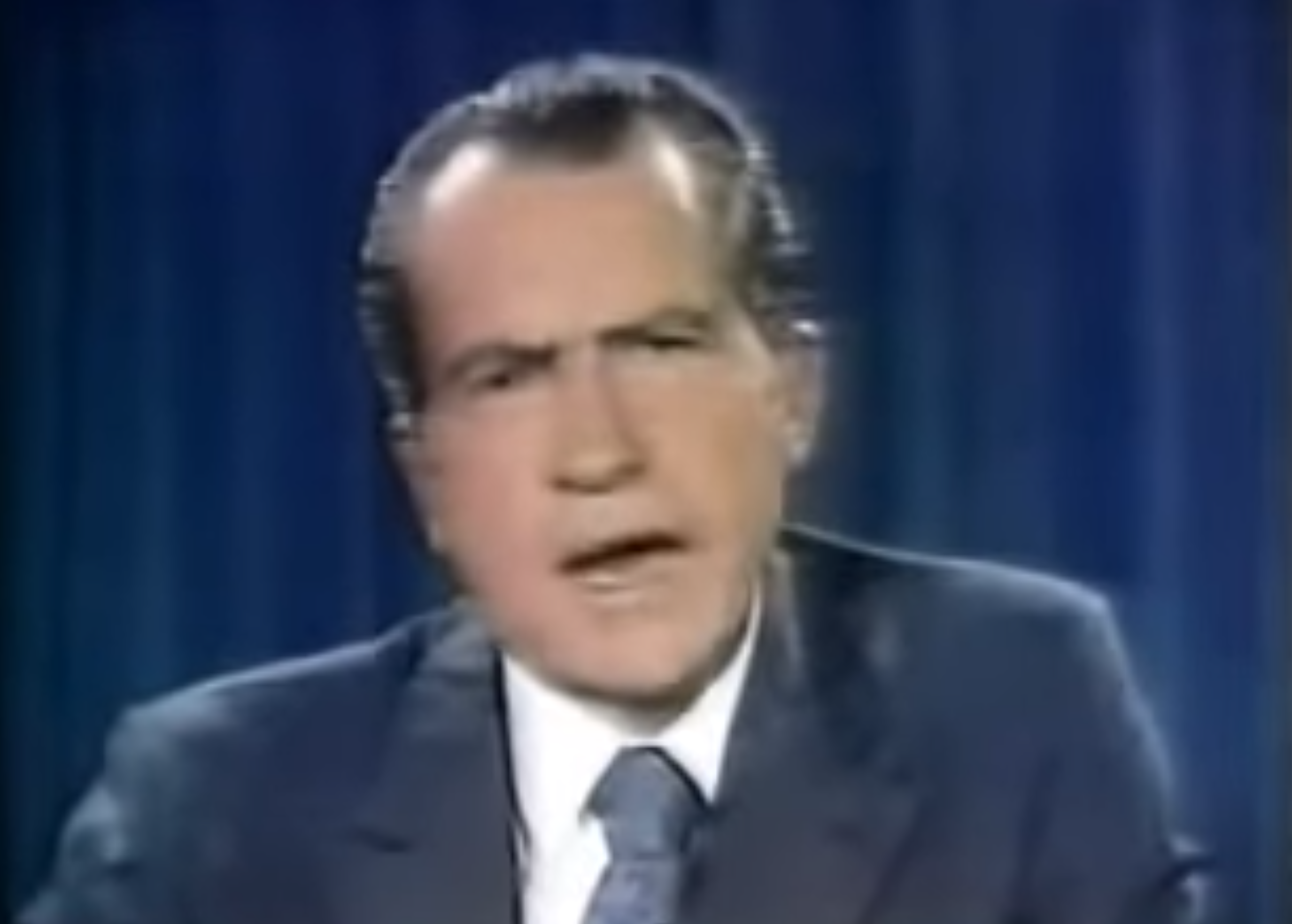
The Nixon Shock refers to a package of three economic measures President Richard Nixon announced in a televised address on the evening of August 15, 1971. These were: closing the gold window, so foreign governments could no longer exchange dollars for gold, a 90-day freeze on wages and prices, the first time the US government had imposed such controls outside wartime, and a 10% surcharge on imports.
Of the three, it’s the gold decision that’s had the lasting historical weight, and the one the name has come to refer to almost exclusively.
| Date announced | August 15, 1971 (a Sunday evening address) |
| Decided at | Camp David, in a closed-door meeting from August 13–15 with 15 advisers, including Fed Chairman Arthur Burns, Treasury Secretary John Connally, and a young Paul Volcker |
| What changed | The US suspended the dollar’s convertibility into gold for foreign governments and central banks |
| Official gold price at the time | $35 per troy ounce |
| Framed as | Nixon directed Treasury Secretary Connally to “suspend temporarily the convertibility of the dollar into gold or other reserve assets" |
| Actual outcome | The gold window never reopened; the Bretton Woods system effectively ended that night |
That last point is really the crux of the Nixon Shock. Nixon’s own language, “suspend temporarily", was doing real political work. It let him frame a permanent policy shift as an emergency measure rather than the end of an era. But the emergency measure never got reversed. Within two years the entire fixed exchange rate system built at Bretton Woods in 1944 had unwound into the floating currencies every major economy still uses.
The wage and price controls and the import surcharge were both allowed to lapse or were phased out over the following two years. The gold decision is the one that stuck, permanently, which is exactly why it’s still being discussed today.
Why Did Nixon End the Gold Standard?
Two Decades of Strain on Bretton Woods
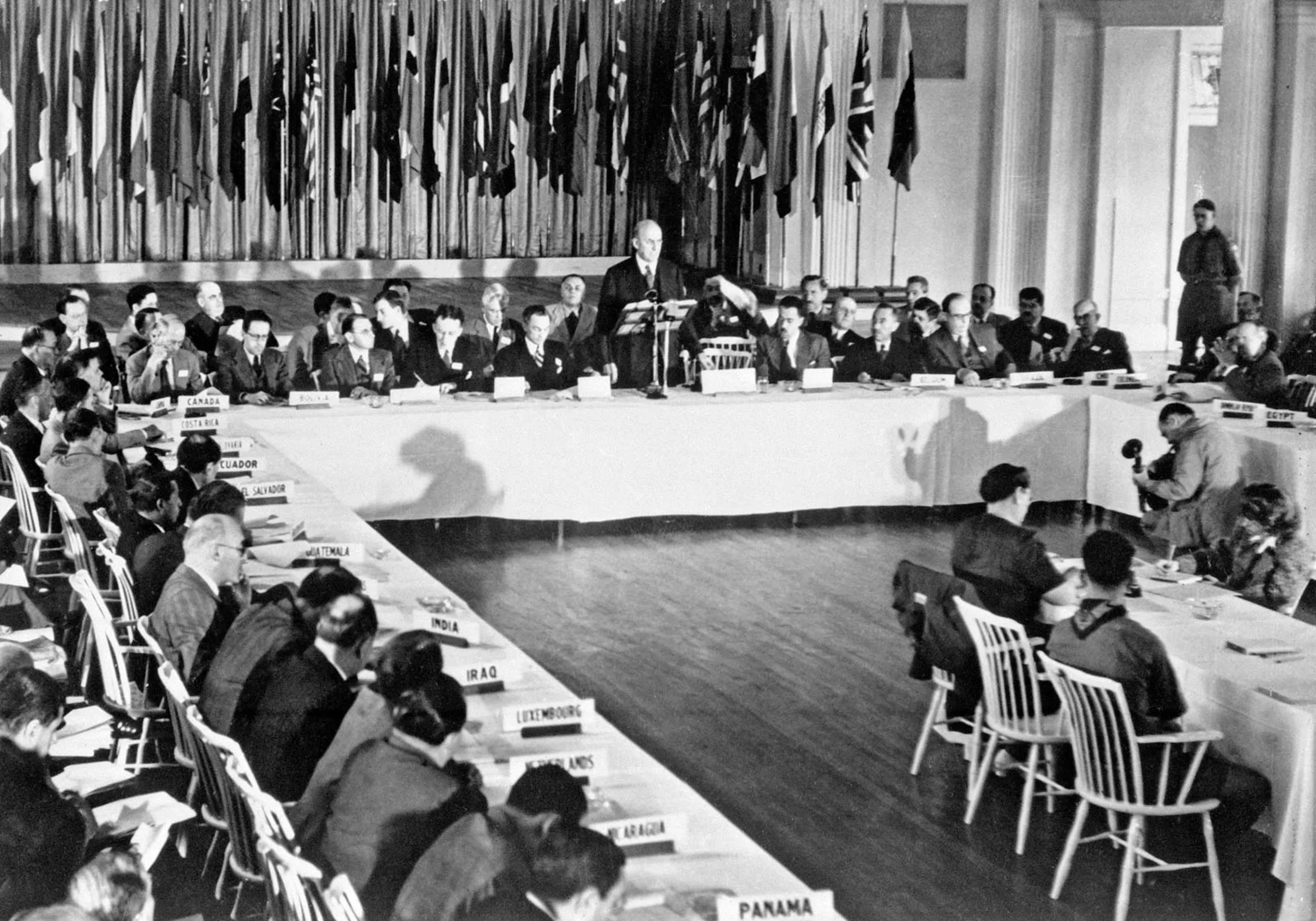
The US had been writing cheques the world’s gold reserves couldn’t cash for the better part of two decades. Persistent trade deficits as Europe and Japan recovered from WW2, the cost of Vietnam, and domestic spending on Great Society programs all pushed a growing volume of dollars into circulation and into foreign central banks, while US gold reserves shrank rather than grew to match.
That strain became impossible to hide in March 1968, when the London Gold Pool, a coordinated effort by the US and other central banks to defend the $35/oz price by selling gold into the market, collapsed under redemption demand it couldn’t meet. Our Gold Standard guide covers that whole mechanism, and the exact numbers behind it, in full.
Nixon’s 1971 Political Calculus
What that broader history tends to leave out is the more immediate, personal calculus Nixon himself was working through in the summer of 1971.
He was heading into a re-election year with unemployment sitting close to 6% and inflation already uncomfortable, a combination his advisers worried could sink his 1972 campaign outright. Treasury Secretary John Connally, who chaired the Camp David weekend alongside Nixon, was reportedly blunt with America’s trading partners about where the burden of adjustment should fall. In a line often attributed to him at a G10 meeting in Rome later that year, he said “the dollar is our currency, but it’s your problem." Whatever the precise wording, and there’s some genuine dispute among historians about exactly how and when he phrased it, the attitude behind it captures why Nixon acted unilaterally rather than negotiating a slower, coordinated wind-down. Protecting the US economy going into an election mattered more to his administration than protecting the system Bretton Woods had built.
That combination, a monetary system already buckling under twenty years of strain, meeting a president under acute short-term political pressure, is what turned “we may need to address this eventually" into “we’re doing this now, this weekend."
August 15, 1971: The Announcement
Nixon’s Sunday evening address itself is covered above, but what happened once the country woke up to it on Monday morning?
Markets React: A Record Dow, and a Scramble for Gold
The Dow Jones Industrial Average jumped 33 points on August 16, 1971, its largest single-day gain up to that point in history, as investors cheered the wage-price freeze and shrugged off the gold decision entirely. The New York Times editorial board was similarly enthusiastic, praising the “boldness" of the move.
Overseas, the reaction was closer to panic than applause. The Bank of Japan spent $1.3 billion defending the dollar’s exchange rate in just two days. Japan’s foreign exchange reserves ballooned from an already-large starting point to $2.7 billion within a week, and $4 billion the week after, as exporters rushed to convert dollars before their value fell further. France, famously, sent a naval vessel to New York to physically retrieve part of its gold reserves rather than leave them exposed to a system it no longer trusted. Within three months the dollar had fallen 7.5% against the Deutsche Mark alone.
The Public Loved It (At First)
Domestically, the reaction was the opposite of the panic playing out in foreign exchange markets. Most Americans understood the announcement primarily through the wage and price freeze, not the gold decision. Polling at the time suggested people felt genuinely protected, both from price gouging, and from what they were told was a currency crisis caused by other countries rather than by US policy. That goodwill carried real political weight: historians generally count the announcement’s initial popularity as one of the factors behind Nixon’s landslide re-election the following year.
The irony, of course, is that the part of the announcement nobody much reacted to at the time, the gold decision, is the one still being written about years later, while the part everyone cheered, the price freeze, quietly expired within a couple of years and rarely gets a mention. What actually happened to the price of gold, and the dollar, once markets had time to digest the change is where the real story is, and it’s worth its own dedicated look.
The Price of Gold Since 1971
What Was the Price of Gold in 1971?
Gold was fixed at $35 per troy ounce in 1971, the rate the US had committed to under Bretton Woods and the price Nixon’s announcement effectively let go of overnight. As of today, gold trades at roughly $4,274 per troy ounce, which means the price of gold has risen more than 120-fold since the Nixon Shock, without a single year of that increase coming from gold itself doing anything differently. The metal hasn’t changed; what it takes to buy it has.
Gold Price Milestones Since 1971
| Year | Price (USD/oz) | Context |
|---|---|---|
| 1971 | $35 | Fixed rate, ended by the Nixon Shock |
| 1980 | $850 (January peak) | Soviet-Afghan war and the Iranian revolution drove a spike |
| 1999 | $252 (low) | The multi-decade low, coinciding with the UK’s sale of 395 tonnes of reserves, since nicknamed “Brown’s Bottom" |
| 2011 | $1,921 (September peak) | European sovereign debt crisis, and end of bull-run following the financial crisis |
| 2020 | $2,075 (August high) | Pandemic-era high |
| 2026 | $5,634.81 (January high) | An all-time high, capping a year in which gold roughly doubled amid heavy central bank buying, Fed rate-cut bets, and renewed inflation and currency concerns |
How Much Has the US Dollar Lost in Value Since 1971?
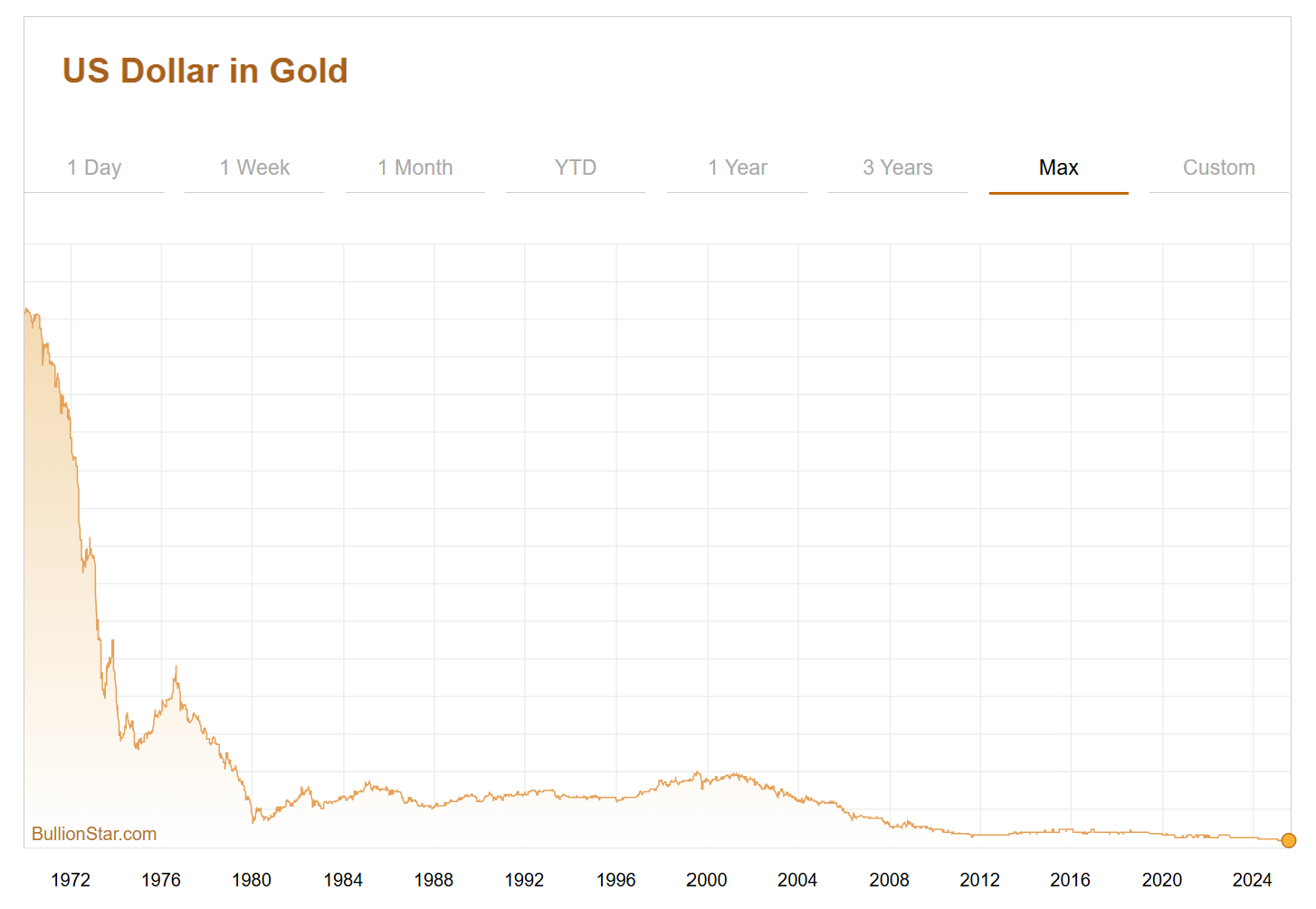
Measured against everyday goods and services (the standard CPI-based measure of inflation), $1 in 1971 has the same purchasing power as roughly $8.25 today, meaning the dollar has lost about 88% of its purchasing power since the Nixon Shock. That’s the figure that answers “how much has the dollar devalued" in the sense most people mean it, what a fixed amount of money actually buys.
Measured against gold specifically, the picture is starker still. At $35 in 1971 versus January 2026’s all-time high of $5,634.81, the dollar’s value in gold terms fell by more than 99%, buying less than one percent of the gold it once did. Even measured against today’s price, off its January high, the drop is still comfortably past 99%. That gap between the two figures, 88% against everyday goods versus 99%+ against gold, is itself a telling data point. It’s a large part of the case for holding gold as a hedge, since gold has preserved, and vastly outpaced, purchasing power in a way the dollar itself hasn’t come close to matching.
Currency Collapse Without Gold: A Cautionary Pattern
The Nixon Shock is often treated as a uniquely American story, but cutting a currency loose from gold has played out the same way in many other countries. Money backed by nothing but government promises tends to lose that promise eventually. Weimar Germany’s hyperinflation and Zimbabwe’s collapse into 100-trillion-dollar notes are the two examples most people already know, and both are still worth a mention here given how directly they illustrate the endpoint of the same dynamic Nixon’s decision set in motion for the dollar, just taken to an extreme the US has not approached.
Our Fiat Currency page covers this pattern in greater detail. We look at Weimar Germany and Zimbabwe alongside Venezuela, Lebanon, Turkey, and Sri Lanka, with the mechanics of exactly how a fiat currency fails.
Why This Still Matters, 55 Years Later
The core lesson of the Nixon Shock hasn’t really changed: a currency backed by nothing but government promise only holds its value for as long as people trust that promise, and that trust isn’t guaranteed to last. What’s changed is that central banks themselves now appear to be acting on that lesson rather than just studying it. Our Gold Standard guide covers the current numbers behind this in full, but the short version is that central bank gold buying has been running at its fastest sustained pace since Bretton Woods itself collapsed, a pattern that only really makes sense if the institutions closest to the mechanics of the system are quietly hedging against a repeat.
The dollar’s position has eroded gradually rather than dramatically, its share of global foreign exchange reserves has slipped from around two-thirds in the mid-2000s to a little over half today, but gradual erosion is exactly the kind of pressure that built for two decades before 1971 and went largely unnoticed until it wasn’t. Nothing about today’s environment points to an imminent repeat of that specific weekend. What it does point to is the same underlying question central bankers, and increasingly individual investors, keep coming back to. What do you hold when trust in a currency is the only thing backing it, and that trust looks less certain than it used to?
Nixon’s answer in 1971 was to sever the dollar’s last tie to gold entirely. Fifty-five years later, a growing number of the institutions that answer to no one but their own reserves are quietly moving the other way, buying gold reserves at record levels.
Frequently Asked Questions
What was the price of gold in 1971?
$35 per troy ounce, the rate fixed under Bretton Woods and still in place on August 15, 1971, when Nixon suspended the dollar’s convertibility into gold. Gold trades at many multiples of that fixed rate today, view the current gold price to compare the two.
How much has the US dollar lost since 1971?
Against everyday goods and services, the dollar has lost about 88% of its purchasing power since 1971 based on CPI inflation data. Measured against gold specifically, the decline is far steeper, over 99%, since gold has risen from that fixed $35 rate to today’s price of well over $4,000 an ounce.
Did Nixon say the gold suspension was temporary?
Yes. Nixon directed Treasury Secretary John Connally to “suspend temporarily" the dollar’s convertibility into gold, framing it as an emergency measure rather than a permanent policy shift. The gold window never reopened, and more than five decades later, it still hasn’t.
When did the US officially leave the gold standard?
The US suspended dollar-gold convertibility on August 15, 1971, ending the gold standard system used globally since the Bretton Woods agreement after WW2.
Could the US return to a gold standard today?
It is unlikely in the near term. The US has not proposed returning to a gold standard, and the modern monetary system is built around the flexibility offered by fiat currency. Returning to a fixed system like a gold standard would cause significant financial volatility.
The Nixon Shock’s Real Legacy
One weekend at Camp David, and one televised address most Americans barely registered at the time, ended up defining the value of the dollar for every year since. The dollar has lost roughly 88% of its purchasing power against everyday goods since that Sunday evening in 1971, and over 99% of its value measured against the gold it was once fixed to. Neither number was inevitable in the way currency devaluation sometimes gets treated as a natural law. It was the direct, traceable result of a decision made by a small group of advisers over one weekend, under real political pressure, with a “temporary" label that was never removed.
Today, central banks are quietly making a similar choice in reverse, and it’s worth understanding the original decision properly before deciding what, if anything, that pattern means for how you hold your own wealth.
If the last 55 years have left you wanting an asset with no government’s promise standing behind it, BullionStar offers a straightforward way to buy physical gold and silver bullion, available for delivery to your door, secure storage, or collection from our Bullion Center at 45 New Bridge Road, Singapore.
Popular Blog Posts by BullionStar
 How Much Gold is in the FIFA World Cup Trophy?
 Essentials of China's Gold Market
 Singapore Rated the World’s Safest & Most Secure Nation
 Infographic: Gold Exchange-Traded Fund (ETF) Mechanics
 BullionStar Financials FY 2020 – Year in Review
 Michael Oliver – Bond Crisis, Gold’s Bull Trend and Silver’s Breakout
 Lehman Brothers Eighteen Years On
 Jim Rogers on Why He’ll Never Sell His Gold and Silver, the Fate of the Dollar, and the Complacency That Worries Him
 Why Gold & Silver Jumped Overnight
 The Gold Paradox: One Price, Two Markets