 Contact
 Help
Help





The Gold Standard: History, Mechanics, and Modern Relevance
 Gold & Silver 101



The term “gold standard" gets used loosely in modern financial conversation, invoked in debates over central bank policy, BRICS de-dollarization proposals, and calls for gold-backed currencies, often without much precision about what it actually meant in practice. It is worth understanding that it wasn’t one fixed system: the gold standard took several distinct forms over more than a century, evolving as governments looked for ways to keep the benefits of a gold-linked currency while reducing its costs.
This guide covers what the gold standard is and how it worked, its history from the classical era through Bretton Woods, why it was ultimately abandoned, and the trade-offs it involved compared to the fiat system that replaced it. We also look at whether a return to gold-backed money is realistic given the increasing role of gold in today’s shifting monetary landscape.
What Is the Gold Standard?
A gold standard is a monetary system in which a country’s currency is directly linked to a fixed amount of gold. Under this system, a government or central bank sets an official price for gold in its currency (the US dollar, for example, was fixed at $35 per troy ounce under Bretton Woods) and commits to converting its currency into that fixed amount of gold on demand. Because the currency’s value is anchored to a finite physical commodity, the money supply can’t be expanded arbitrarily. New currency generally has to be backed by new gold reserves.
That’s the basic definition, but “the gold standard" was never one fixed system. There were several distinct types of gold standard over time, as governments looked for ways to preserve the discipline of a gold link while reducing the practical cost of using gold as everyday money.
This section, and later sections on this page, are based on previous guest posts published on BullionStar’s Blog by JP Koning, who writes on monetary economics, central banking, precious metals, economic history, and financial technology: “Types of Gold Standards" and “Life Under a Gold Standard." As with all guest contributions, BullionStar does not necessarily endorse or oppose the views expressed. You can find more of JP Koning’s writing in his BullionStar blog archive.
Gold Coin (Specie) Standard
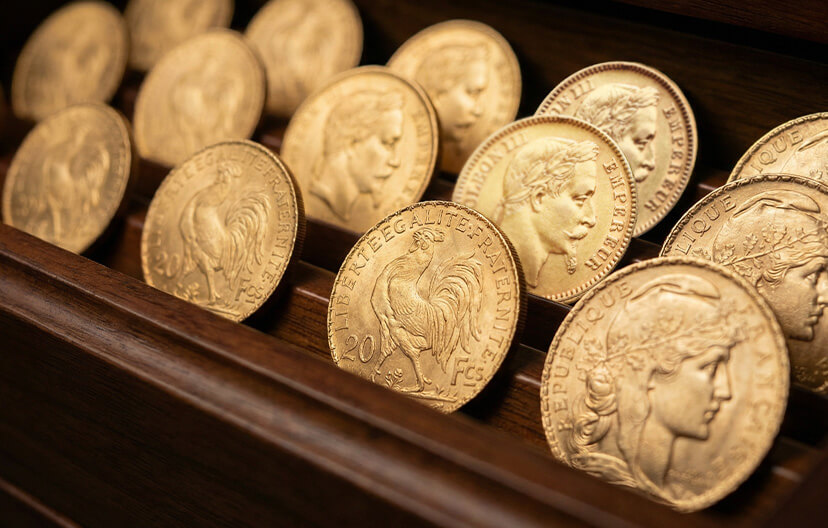
The earliest and most literal form of gold standard, in which gold coins circulated directly as the standard money. Many countries for much of history operated on the gold specie standard, or a bi-metallic standard with both gold and silver. Coins were produced to exact standards, carrying the specified amount of metal that gave them their value. While other forms of gold standard relied on convertibility between the currency and a fixed amount of gold, the specie standard put the actual metal into the hands of the people.
Gold Bullion Standard
First proposed by David Ricardo in 1816 and adopted in Britain roughly a century later, after WWI. Gold coins were withdrawn from circulation entirely, and the mint stopped producing them for public use. Currency remained redeemable, not for coins, but for raw gold bars, reducing the cost of keeping gold in everyday circulation while preserving convertibility.
Gold Exchange Standard
Rather than holding gold reserves directly, a country holds its reserves in the currency of another country that is itself on a gold standard. The most significant example of this system is Bretton Woods (1944–1971). The US dollar was convertible into gold, and other major currencies were pegged to the US dollar rather than to gold directly.
Limping (Partially Convertible) Standard
Convertibility is restricted to certain parties rather than open to the public. The US ran a version of this between 1934 and 1971: the Gold Reserve Act of 1934 ended the ability of private citizens to redeem dollars for gold, while foreign governments and central banks retained that right, up until the Nixon Shock ended it entirely.
The shift through these forms of gold standard unfolded over roughly a century and a half, as discussed in the next section.
A Brief History of the Gold Standard
The forms covered above existed in various combinations for centuries, but when most people say “the gold standard," they mean the period running from the late 1800s to 1971, when gold-linked currencies briefly became the dominant global monetary system, then unravelled in stages.
The Classical Gold Standard (1879–1914)
By the 1870s, most major economies had adopted gold as the basis for their currencies. The US made this official in 1879, resuming convertibility of the dollar into gold after suspending it during the Civil War, joining Britain (on gold since 1816) and Germany (1871) in what’s now called the classical gold standard era. The US position was later cemented by the Gold Standard Act of 1900, signed by President McKinley, which legally defined the dollar as 25.8 grains of gold and ended decades of political fighting over bimetallism. For roughly 35 years, this created something close to a unified international monetary system: currencies were fixed to gold, and therefore fixed to each other, and capital moved relatively freely across borders.
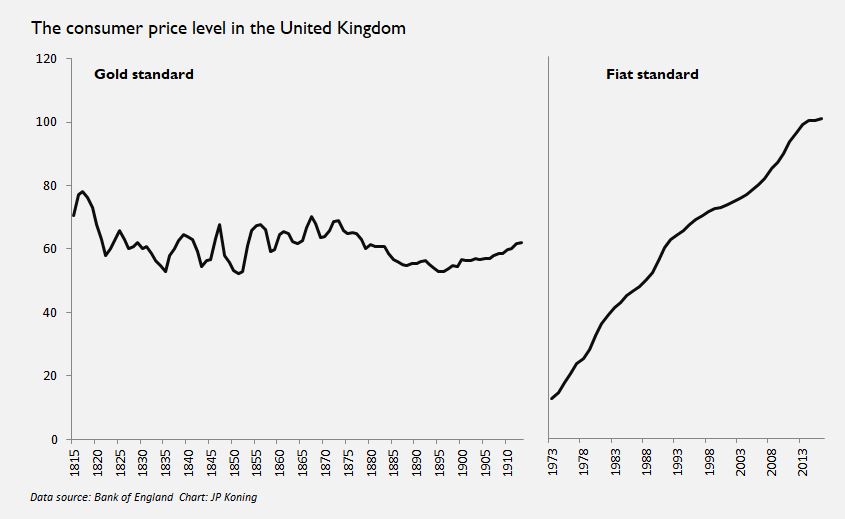
Life under this system looked very different from modern experience. Because the money supply couldn’t be created at will, long-run consumer prices in gold standard countries were remarkably stable; UK prices in 1913 sat at roughly the same level as in 1875. But short-term price movements were often far more volatile than today: UK consumer prices rose 7% in 1847, then fell 14% the following year. That trade-off, long-run stability paired with short-run unpredictability, is a defining feature of gold standard economies, and we come back to it in the pros and cons section below.
The classical era ended abruptly with the outbreak of WWI in 1914, when the major powers suspended gold convertibility to help fund war spending.
The Interwar Period
The gold standard’s return after WWI was short-lived and, in Britain’s case, badly mismanaged. Seeking to restore pre-war financial credibility, Britain returned to gold in 1925 at the same exchange rate that had applied before the war ($4.86 to the pound), a decision championed by then-Chancellor Winston Churchill. Wartime inflation, however, had made the pound worth less in real terms, so pegging back to the old rate left sterling significantly overvalued. Exports became uncompetitive, unemployment climbed, and economist John Maynard Keynes attacked the decision in print.
The strain proved unsustainable. As the Great Depression took hold and investors rushed to convert currency into gold, Britain’s reserves drained rapidly, forcing it to abandon the gold standard in September 1931.
The US followed a related but distinct path. In 1933, President Franklin Roosevelt issued the infamous Executive Order 6102, requiring Americans to hand over their gold coins, bullion, and gold certificates to the Federal Reserve in exchange for cash at the official rate of $20.67 per ounce. The following year, the Gold Reserve Act of 1934 revalued gold to $35 per ounce, a de facto devaluation of the dollar, and transferred ownership of all monetary gold in the US to the Treasury. By the mid-1930s, most of the world’s major currencies had left the classical gold standard behind.
Bretton Woods (1944–1971)
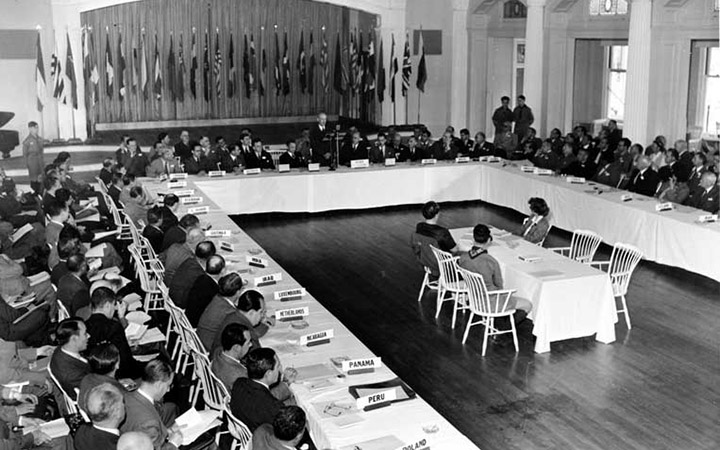
As WWII drew to a close, 44 Allied nations met in Bretton Woods, New Hampshire, in 1944 to design a new international monetary system aimed at avoiding the currency chaos of the interwar years. The result fixed the US dollar to gold at $35 per ounce, with every other member currency pegged to the dollar rather than to gold directly, a structure known as a gold exchange standard (see above).
The system held for roughly 25 years, but by the 1960s, persistent US trade deficits, overseas military spending, and domestic programs like the Great Society had pushed more dollars into circulation than the US had gold to redeem, with much of it accumulating in foreign central banks. Confidence eroded, and in 1971, President Richard Nixon suspended the dollar’s convertibility to gold altogether, an event that effectively ended the gold standard era for good. We cover exactly why that happened next, and in full detail in our guide, The Day the Dollar Lost Its Gold: The Nixon Shock.
Why Was the Gold Standard Abandoned?
At its core, the gold standard was abandoned because the US issued more dollars than its gold reserves could support. Once that became clear to the rest of the world, the system couldn’t hold. Through the 1950s and 60s, persistent US trade deficits, the cost of the Vietnam War, and domestic spending on programs like the Great Society pushed a growing volume of dollars into circulation, much of it accumulating in foreign central banks that held the right, under Bretton Woods, to convert those dollars into gold at $35 an ounce.
US gold reserves didn’t keep pace. They fell from a peak of roughly $24.8 billion in 1949 to around $10 billion by 1971, even as the pool of foreign-held dollars theoretically convertible into gold kept growing. The strain became visible in March 1968, when the London Gold Pool, a coordinated effort by the US and major central banks to defend the $35/oz price by selling gold into the market, collapsed after redemption demand outpaced what the pool could supply.
When Did the US Leave the Gold Standard?
On August 15, 1971, President Richard Nixon announced in a televised address that the US would suspend the dollar’s convertibility into gold. In his own words, he directed Treasury Secretary John Connally to “suspend temporarily the convertibility of the dollar into gold or other reserve assets, except in amounts and conditions determined to be in the interest of monetary stability and in the best interests of the United States." Nixon called the move temporary. The gold window never reopened, and within two years the fixed exchange rate system built at Bretton Woods had given way entirely to floating currencies. Every major currency, including the dollar, has been fiat money ever since.

This moment is widely known as the Nixon Shock. For the full story of the decade of pressure that led to it, and what happened immediately after, see our detailed account: The Day the Dollar Lost Its Gold: The Nixon Shock.
Ultimately, the gold standard wasn’t abandoned because gold failed as a monetary anchor. It was abandoned because the discipline it imposed on government spending and money creation became too constraining once war costs, welfare spending, and persistent deficits collided with a fixed, external limit. That tension, monetary flexibility versus monetary discipline, is central to the trade-offs covered next.
Pros and Cons of the Gold Standard
The trade-off at the heart of the gold standard debate is simple to state and hard to resolve: a gold-linked currency delivers long-run price stability and forces fiscal discipline, but it does so by giving up the flexibility to respond to recessions, wars, and financial crises with a printing press.
| Factor | Gold Standard | Fiat Currency |
|---|---|---|
| Money supply | Constrained by gold reserves | Set by central bank policy |
| Long-term price stability | Strong — price levels can be flat across decades | Weak — persistent inflation is the norm |
| Short-term price volatility | High — sharp year-to-year swings | Low — inflation typically moves in a narrow, predictable band |
| Response to recessions | Limited — can’t expand the money supply freely to stimulate | Flexible — central banks can cut rates and create money |
| Government spending discipline | High — deficits constrained by convertibility | Low — deficits can be financed by issuing currency or debt |
| Trade imbalances | Self-correcting via gold outflows | Persist longer; adjusted through currency depreciation |
| Vulnerability to “runs" | High — a convertibility promise can be tested and broken | Low — there’s no fixed promise to break |
The case for the gold standard rests mainly on that top row and the two below it. Because money can’t be created at will, gold standard economies have historically avoided the sustained inflation that fiat currencies are prone to; UK and US price levels were roughly flat across the entire classical gold standard era. It also imposes real discipline on governments: running large, persistent deficits is harder when your currency’s convertibility depends on maintaining adequate gold reserves.
The case against centres on flexibility, or the lack of it. As JP Koning’s analysis of price behaviour under a gold standard shows, that same rigidity that delivers long-term stability also produces sharp short-term volatility: UK consumer prices swung from +7% to -14% in consecutive years during the classical era, a level of unpredictability no fiat economy has experienced in peacetime. A gold standard also leaves governments with little room to respond to a recession or financial crisis: a central bank can’t lower rates or expand the money supply to stimulate demand if doing so would strain gold convertibility. That inflexibility helped turn the early 1930s downturn into the prolonged Great Depression in gold standard countries, and it’s the primary reason every major economy eventually abandoned the system.
Could We Return to the Gold Standard?
A full, formal return to a classical gold standard, where a currency is legally convertible into a fixed weight of gold, is unlikely in the near term. No major economy has proposed one, and the practical obstacles are significant: modern economies are far larger relative to the world’s gold supply than they were a century ago, and no government has shown willingness to give up the monetary flexibility to respond to recessions and crises that a gold peg would take away. What’s actually happening is different, and arguably more interesting: gold is quietly regaining a larger informal role in the international monetary system, without any government committing to full convertibility.
Central Bank Gold Buying
The clearest evidence of gold’s increased role in the monetary system is central bank behaviour. Annual purchases of gold reserves exceeded 1,000 tonnes in each of 2022, 2023, and 2024, the most sustained period of central bank accumulation since Bretton Woods collapsed in 1971, and a record 43% of central banks say they plan to add to their gold reserves in 2026, up from 29% just two years earlier. Much of this traces back to a single event: the freezing of roughly $300 billion of Russia’s foreign exchange reserves by Western governments after its 2022 invasion of Ukraine, which demonstrated to every other central bank that dollar-denominated reserves can be politically weaponized. Gold, which can’t be frozen or sanctioned by a foreign government, became correspondingly more attractive as a reserve asset.
BRICS and Gold-Backed Currency Proposals
BRICS (originally Brazil, Russia, India, China, and South Africa) is a bloc of major emerging economies founded in 2009 as a counterweight to Western-dominated financial institutions and the US dollar’s role in global trade. It has since expanded to ten full members, adding Egypt, Ethiopia, Indonesia, Iran, and the UAE, plus a tier of “partner countries," together representing roughly 41% of world GDP on a purchasing-power basis.
The bloc has discussed a shared currency for years, but as of 2026 there’s no confirmed launch date, and it remains in the discussion and infrastructure phase. The concrete step so far is the “Unit," a digital trade settlement token quietly piloted in October 2025, backed 40% by gold and 60% by a basket of BRICS currencies, with the New Development Bank’s president confirming “agreement in principle" to use it for settlement. A full platform isn’t targeted until around 2030. In the meantime, the more realistic near-term agenda, under India’s 2026 BRICS chairship, is technical interoperability between members’ central bank digital currencies (the e-Rupee, China’s digital yuan, Brazil’s DREX, and the UAE’s dirham CBDC) rather than a single new gold-backed unit.
Genuine obstacles remain: transparently valuing and auditing gold reserves across nations with very different disclosure standards is a real logistical problem, and geopolitical friction between members, China and India’s border tensions being the clearest example, complicates any move that requires close coordination.
Russia’s Gold Pivot
Russia is often cited as the leading example of a central bank pivoting toward gold, and it has been a major accumulator, going as far as folding silver into its state reserves as part of a broader de-dollarization push. The more recent picture is less clean-cut, however: in late 2025, Russia’s central bank began selling gold from its reserves into the domestic market, using it to support the rouble and cover budget shortfalls arising from the invasion of Ukraine. That’s a useful reminder that gold reserves function as a financial buffer to be drawn on under pressure, not a one-way commitment to de-dollarization.
The Dollar’s Reserve Status
The US dollar’s share of global foreign exchange reserves has fallen from 66% in 2006 to 57% in 2026, a gradual eight-percentage-point erosion over two decades rather than a collapse. No other currency, gold-backed or otherwise, has emerged as a clear replacement for the dollar’s role in global trade and reserves.
Taken together, the realistic answer to “could we return to the gold standard" is probably no, not in the formal sense the term historically describes. What’s underway instead is a slow rebalancing toward gold as one reserve asset among several, driven by central banks hedging against geopolitical risk rather than any government preparing to reintroduce convertibility.
Frequently Asked Questions
How did the gold standard work?
A government or central bank fixed its currency to a specific weight of gold and committed to converting currency into that amount of gold on demand. This meant the money supply couldn’t be expanded without acquiring more gold to back it, which is what gave gold standard currencies their long-run price stability. The exact mechanics varied across the different forms the standard took, from gold coins circulating directly, to paper currency redeemable for bullion, to currencies pegged to another country’s gold-backed currency, as under Bretton Woods.
What’s the difference between the gold standard and fiat currency?
Under a gold standard, a currency’s value is fixed to gold and the money supply is constrained by available reserves. Under fiat currency, which every major economy uses today, a currency’s value isn’t backed by any physical commodity, and central banks can expand or contract the money supply through policy decisions. That gives fiat systems far more flexibility to respond to recessions and crises, at the cost of the automatic price discipline a gold standard provides.
Is the gold standard still used?
No country operates a formal gold standard today. The last vestige of the international system ended in 1971, when the US suspended the dollar’s convertibility into gold. Every major currency has been fiat since.
Can we go back to the gold standard?
A full, formal return to a gold standard is unlikely in the near term. No major economy has proposed one, and governments have shown little appetite for giving up the monetary flexibility a gold peg would take away. What’s happening instead is a gradual, informal shift: central banks are holding more gold in reserve and exploring gold-referenced settlement mechanisms, without any government committing to convertibility.
Did Bretton Woods restore the gold standard?
Only partially. Bretton Woods created a gold exchange standard, not a full return to a gold coin or bullion standard. The US dollar remained directly convertible into gold at $35 an ounce, but other member countries pegged their currencies to the dollar rather than to gold itself. That indirect link held until 1971, when the US suspended dollar convertibility and ended the system entirely.
Are any countries on the gold standard today?
No country runs a national currency on a formal gold standard. There are exceptions worth noting at the margins: Zimbabwe introduced a partially gold-backed currency, the ZiG, in 2024 to try to restore confidence after its previous currency collapsed, and various private and digital gold-backed tokens exist. None of these amount to a major economy operating on a gold standard in the historical sense.
The Gold Standard Today: Key Takeaways
The gold standard was never a single, unchanging system. It moved from gold coins circulating as everyday money, to bullion-backed paper currency, to the dollar-centred exchange standard of Bretton Woods, each step trading away some of gold’s discipline for lower cost and greater convenience. What stayed constant across every version was the trade-off: price stability and constrained government spending, in exchange for giving up the flexibility to respond to wars, recessions, and financial crises with monetary policy. That trade-off, not any flaw in gold itself, is what eventually broke the system in 1971.
More than 50 years on, that same trade-off is why a formal return to the gold standard remains unlikely, even as gold’s role in the global monetary system quietly grows. Central banks are buying gold at the fastest pace in decades, and proposals like BRICS’s gold-linked settlement token suggest more may follow. None of this points to a government re-imposing convertibility any time soon, but it does reflect a broader recognition that gold retains a quality few other assets can offer: it isn’t anyone’s liability, and it can’t be devalued by decree.
For investors interested in that same quality on a personal level, BullionStar offers a straightforward way to buy and store physical gold and silver, including vault storage in Singapore, the United States, and New Zealand. Browse our gold products, or visit our Bullion Center at 45 New Bridge Road, Singapore.

Popular Blog Posts by Gold & Silver 101
 An Introduction to Gold & Silver Investing
 Should I Invest in Gold, Silver, or Platinum Bullion?
 Gold Coins vs Gold Bars: Which Is Better?
 How Is Gold Taxed in Singapore? The IPM GST Exemption Explained
 Storing Precious Metals, Gold, and Silver Bullion
 Gold & Silver Bullion Investing FAQs
 999 Fine Silver: Investment-Grade Silver Explained
 Gold Savings Account vs Bullion Savings
 Silver Purity: The Complete Guide
 How to Invest in Silver: A Complete Guide