 Contact
 Help
Help






Gold’s Monetary Rediscovery: The Bull Market Is the Symptom, Not the Story

 Ronan Manly
 2 Comments



“How central banks, Sovereign Wealth Funds, and Asian investors are rediscovering what they always knew about the world’s oldest monetary asset”
1. A Rediscovery of Gold, Not a Rally
In the second quarter of 2026, central banks bought a combined 289 tonnes of gold, the highest on record for any second quarter, and a 62% increase on the same period in 2025.
This central bank buying was also five times higher than the revised first quarter 2026 figure of 57 tonnes. More revealing than the magnitude, however, was the timing, as central banks accelerated their purchases of gold even as gold prices corrected sharply during the second quarter. That behavior is difficult to explain purely as momentum chasing and is more consistent with strategic reserve accumulation, with central banks buying the monetary asset itself, rather than simply buying into a rising price.
While the financial media’s labelling of the price action as a ‘gold bull market’ is technically correct, this description identifies the symptom rather than the underlying phenomenon. What we are witnessing is better understood as a monetary rediscovery, a structural shift in which gold is assuming a more prominent role within the global monetary system as the world’s oldest and preeminent monetary asset, with no issuer, no counterparty and no sovereign promise behind it.
The leading actors in this rediscovery have been central banks. Gold has, of course, never ceased to be a monetary asset, and central banks have always known this. They have called gold a “war chest," a “line of defence," an “emergency reserve," and an “anchor of trust."
“Why the World’s Central Banks hold Gold – In their Own Words”, 20 March 2018
But what changed in recent years, and noticeably accelerated since the freezing of Russian foreign exchange reserves in 2022, was central banks becoming less inhibited in publicly saying that gold is a monetary asset, and in the system’s willingness to act on what central banks always knew. The sanctions imposed on Russia’s foreign exchange reserves removed the inhibition, and some of the intellectual conditioning that had relegated gold to the margins of modern reserve management began to wear off.
This helps explain why the current gold market looks different from a conventional cyclical price rally. Central banks are not simply responding to the price. The question is not only why gold is going up, but why increasingly important holders of capital are willing to exchange more units of the world’s principal reserve currency for an ounce of a non-sovereign monetary asset.
The answer is that they are increasingly treating gold as a form of monetary insurance, as an asset without counterparty risk, and when held domestically, an asset that is outside the political jurisdiction of another sovereign.
This rediscovery of gold’s true role has created a disconnect in which central banks and other sovereign actors have been increasing their exposure to gold, while private investors remain overwhelmingly positioned in equities, bonds and other financial assets. Gold accounts for just 2.7% of global liquid financial assets, compared with a historical peak of 8.3%. Even a modest shift in this enormous pool of capital could translate into substantial increased demand for gold.
2. The 2022 Shock – When the Risks become Real
The monetary rediscovery of gold did not begin in 2022. Central banks had already been accumulating gold for more than a decade and understood its distinctive characteristics as a reserve asset. What changed in 2022 was not central banks’ knowledge of gold, but the consequences of not holding enough of it.
On 28 February 2022, the US, European Union and their allies announced measures to immobilise approximately $300 billion of Russia’s foreign-exchange reserves held in Western financial institutions, making it one of the largest sovereign asset freezes in modern history. Nearly half of Russia’s reserves, held primarily in dollars, euros and other foreign currencies, became inaccessible, while its domestically accumulated and stored gold remained untouched.
For reserve managers around the world, the episode demonstrated a distinction in reserve assets that had always existed, but had previously been easier to ignore, namely that a sovereign can own a foreign financial asset without having complete control over it.
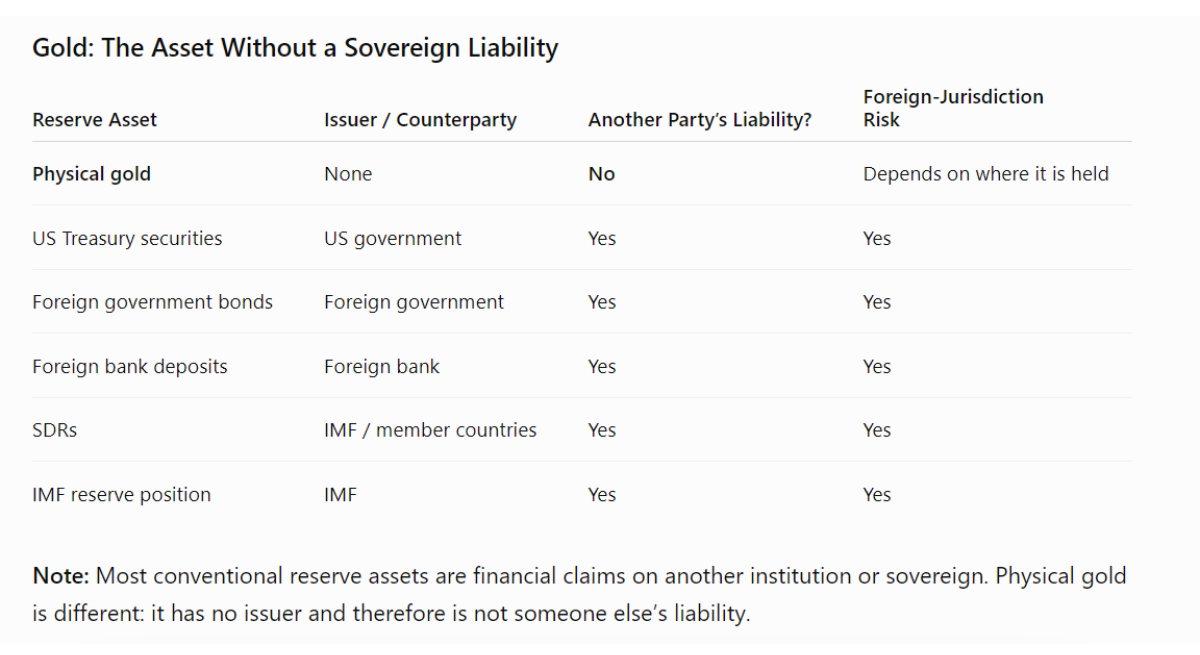
Dollar-denominated securities, euro-denominated bonds, and deposits in foreign financial institutions are ultimately claims embedded within another jurisdiction’s legal and financial architecture. Their accessibility depends upon custodians, settlement systems, issuers and, ultimately, the willingness of the relevant jurisdiction to permit access. Physical gold held domestically is different, as it has no issuer or counterparty. It is not another sovereign’s liability and does not require another government or financial system to remain politically accessible.
The crux of the issue raised in 2022, therefore, is not that central banks suddenly discovered gold, but that what had previously been an abstract geopolitical risk became a demonstrated feature of the international monetary system.
Russia is perhaps the clearest example. It had been accumulating gold for years precisely because it recognised the political and legal risks associated with foreign-held reserves. In 2015, Dmitry Tulin, then First Deputy Governor of the Bank of Russia, was quoted by Reuters as saying:
Russia’s strategy therefore predates the 2022 events by many years. What changed in 2022 was that the risks Russia had been preparing for became visible in practice, and were no longer theoretical. They also removed much of the inhibition against preparing for those risks.
The shift was captured by the idea articulated by former Credit Suisse strategist Zoltan Pozsar, who argued that the freezing of Russian reserves marked a break with the previous architecture of “Bretton Woods II” and the emergence of what he called “Bretton Woods III”, in which commodities and gold would assume a greater monetary role alongside or outside conventional Western financial assets. In other words, the risk hierarchy of US Treasuries, foreign exchange reserves and gold reserves had been challenged by the weaponisation of the financial infrastructure itself.
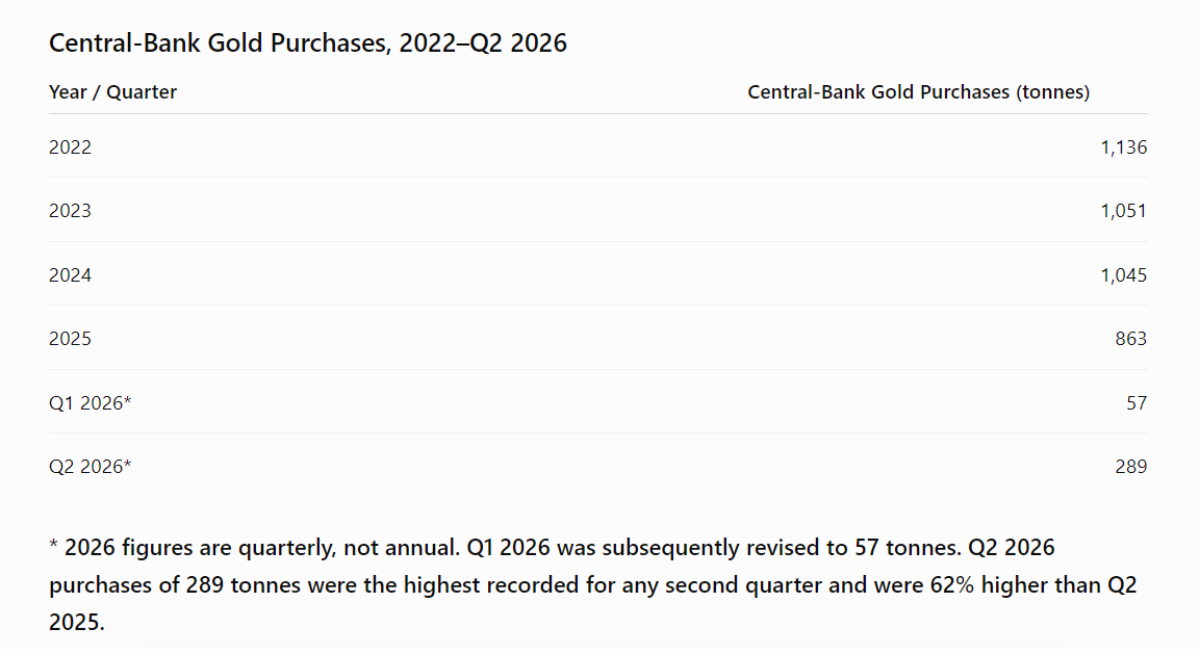
The data that followed the 2022 shock provides evidence that this was more than a temporary reaction. According to the World Gold Council, central banks purchased approximately 1,136 tonnes of gold in 2022, 1,051 tonnes in 2023, 1,045 tonnes in 2024 and approximately 863 tonnes in 2025. In Q2 2026, they purchased a further 289 tonnes, the highest second-quarter total on record and 62% higher than Q2 2025. Most importantly, central banks continued buying even as gold prices corrected sharply. The behaviour suggests that the marginal official-sector buyer is increasingly price-insensitive: the objective is to acquire physical gold, not simply to profit from gold’s appreciation.
The major central-bank buyers are also increasingly diverse. Poland has increased its gold reserves from just 14 tonnes in 1996 to more than 630 tonnes, with a target of 700 tonnes, and has been the largest buyer so far in 2026, adding over 82 tonnes.
Governor Adam Glapiński has described gold as an “anchor of trust” during periods of stress and crisis. China has also maintained sustained gold accumulation, with reported reserves now around 2,300 tonnes, while its broader importance extends to the physical market and the growing role of Shanghai and Asia in global gold demand and price discovery.
The Czech Republic is targeting 100 tonnes by 2028, while Hungary holds approximately 110 tonnes and describes gold as a “major line of defence under extreme market conditions.” These countries have very different economies, monetary systems and geopolitical relationships. Their common behaviour therefore points to something broader than simple de-dollarisation: they are diversifying the reserve architecture by increasing exposure to an asset that is nobody else’s liability.
The changing perception of gold is reflected not only in how much central banks hold, but increasingly in where they hold it. If jurisdiction can affect access to financial assets, physical custody becomes a strategic consideration. France provides a particularly clear recent example. Between July 2025 and January 2026, the Banque de France replaced approximately 129 tonnes of gold held in New York with European-purchased bars, bringing its entire 2,437-tonne reserve into domestic custody.
The Banque de France describes the operation as technical rather than geopolitical, but reading between the lines there is more to it than simply moving gold from one vault to another. The Banque de France replaced the older US Assay Office bars held in New York with newly purchased European bars, while bringing the entire reserve into domestic custody. Gold stored domestically does not depend on a foreign custodian, settlement system or government permitting access. France chose to eliminate its remaining custody risk, by eliminating New York gold storage.
The broader trend is therefore not simply that central banks want more gold, but increasingly that central banks want more gold and greater control over where that gold is physically held. In other words, there is growing emphasis on sovereign physical control of strategic monetary assets.
Surveys Confirm the Shift
Central bank surveys reinforce the behavioural evidence. The World Gold Council’s 2026 Central Bank Gold Reserves Survey found that 89% of reserve managers expect global central-bank gold holdings to increase over the next 12 months, while a record 45% expect their own institutions to increase holdings. An overwhelming 93% of respondents now hold gold, while 90% cited its performance during crises and 84% its role as a long-term store of value. Meanwhile, 74% expect the dollar’s share of global reserves to decline over the next five years.
The language used by central banks also makes clear that this is not a post-2022 invention. The Hungarian central bank calls gold a “major line of defence under extreme market conditions”, Poland describes it as an “anchor of trust”, and the Bundesbank refers to it as an “emergency reserve”. What has changed is the geopolitical environment and the willingness to act on what central banks had long understood.
The freezing of Russia’s reserves did not begin the monetary rediscovery of gold. It was the moment when the abstract became real.
3. Physical Reality: Supply, Infrastructure and Regulation
If central banks are the engine of the new gold demand, physical supply is the constraint. And that constraint is considerably tighter than the headline numbers suggest.
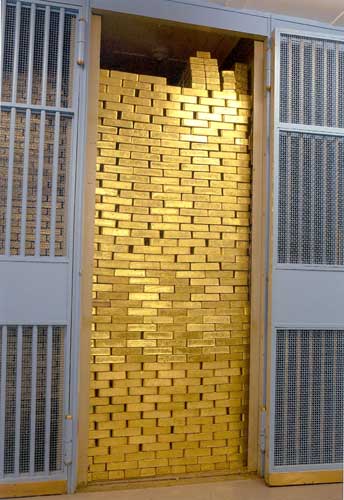
There is no shortage of gold in the world. There are more than 220,000 tonnes of gold above ground, accumulated over thousands of years.
However, the amount of gold that exists is not the same thing as the amount of gold that is available, and there is a much smaller quantity of gold that is actually available to be bought. While the London LBMA system vaults (including the Bank of England) claim to have held 9,534 tonnes at the end of July 2026, this figure tells us nothing about how much gold is actually available to a buyer who wants physical metal today.
London’s vaults are not warehouses of gold waiting for buyers. Every tonne is already owned by someone. Some belong to central banks, some to physically backed ETFs, some to commercial banks, institutions, investors, jewellery companies and other market participants. Gold can therefore be physically sitting in a London vault without being available for purchase.
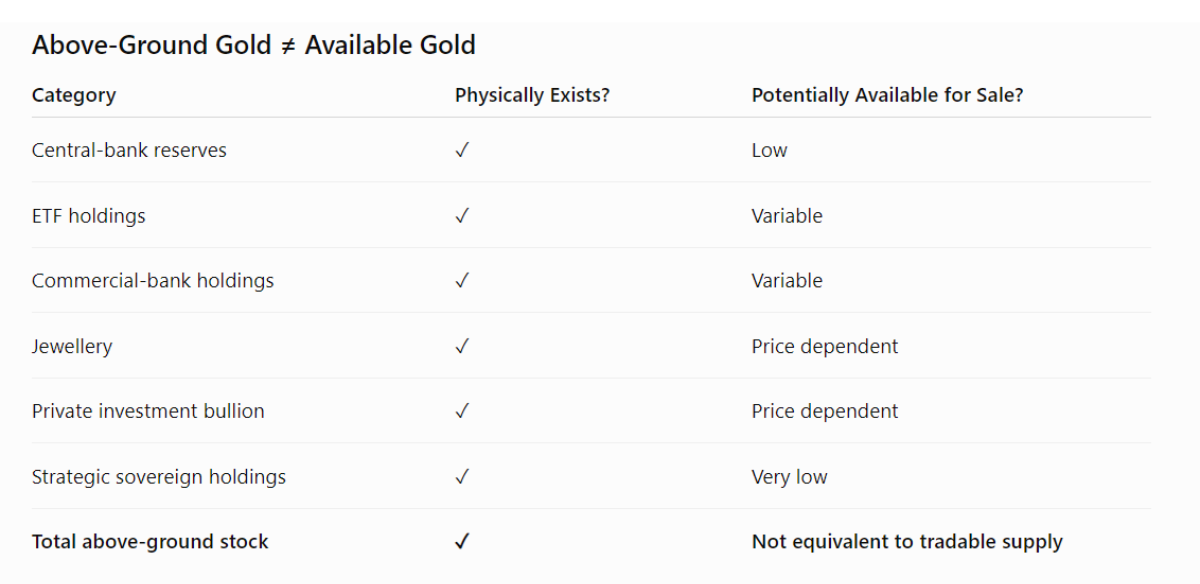
The relevant question is not simply how much gold exists, nor even how much is stored in London. It is how much gold its current owners are willing to sell at the prevailing price. A central bank holding gold as a strategic reserve may have little interest in selling it at anything close to the prevailing market price. A sovereign wealth fund acquiring gold as a long-term monetary asset may have similarly low turnover. An investor holding physical bullion as monetary insurance may also have a high threshold before selling. Other owners are much more price-sensitive: jewellery holders, traders, leveraged investors and some financial investors may sell when prices rise sufficiently or when they need liquidity.
A central bank adding gold to its reserves is therefore not necessarily trying to trade around the price. It may have a target allocation or a target number of tonnes. If it decides that it wants another 50 or 100 tonnes, a 5% increase in the gold price does not necessarily change the strategic objective. It still wants the gold. The seller, however, may be price-sensitive. The price therefore has to perform a very different function: it has to persuade an existing owner to give up physical metal.
Gold’s supply response is fundamentally different from that of most commodities. Global mine production has remained broadly around 3,000–3,300 tonnes a year, despite the enormous rise in the gold price. Higher prices can stimulate exploration and new mine development, but the response takes years, not months. A central bank can decide today to buy more gold; the mining industry cannot produce hundreds of additional tonnes next year.
This gives gold an unusually high stock-to-flow ratio. Almost all the gold ever mined still exists, while annual mine production adds only a small increment to that enormous stock. When demand rises sharply, therefore, the immediate supply response must come primarily from existing gold changing hands.
Recycling is the quickest mechanism, but recycling does not create gold; it changes who owns it. Higher prices bring jewellery, coins and investment bars back to market as price-sensitive holders sell. But if that metal is then absorbed by central banks, sovereign wealth funds or other strategic buyers, it can move from an owner with a relatively low reservation price to another with a much higher one. The gold has been recycled, but it has not necessarily returned to the tradable float.
The distinction between paper and physical gold becomes important when we look at who is buying. The London market can accommodate enormous turnover because much of the trading involves financial claims rather than the immediate transfer of physical bars. That works perfectly well when participants are trading price exposure, hedging or arbitraging between markets.
But a central bank accumulating reserves has a different objective. It is not buying exposure to gold; it is transferring gold onto its balance sheet. The same is true of a sovereign wealth fund building a strategic holding or an institution seeking allocated physical metal. These buyers ultimately have to acquire the underlying bars.
A market can therefore be highly liquid in gold exposure while being much less liquid in physical gold. When the marginal buyer increasingly wants the physical gold itself, the relevant question becomes how much physical metal can actually be sourced without materially moving the price.
That question becomes particularly important as the centre of gravity of physical gold demand and infrastructure continues to shift towards Asia.
The Eastward Shift
The physical centre of gravity of the gold market is shifting eastward. China and India are enormous sources of physical demand, while Shanghai, Hong Kong, Singapore, Dubai and Mumbai are increasingly important centres for trading, clearing, storage and distribution. London remains the world’s principal wholesale OTC market and one of its major vaulting and liquidity centres, but it increasingly operates alongside a growing Asian and Middle Eastern physical network.
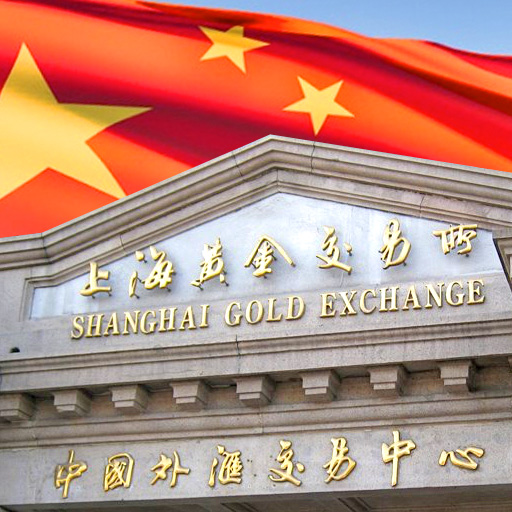
When Asian buyers are willing to pay a premium for immediate physical metal, that premium provides a signal about availability that may not be apparent from financial-market turnover.
Where physical liquidity concentrates, price discovery follows. The traditional London – New York axis remains central, but it increasingly operates alongside an Asian and Middle Eastern network through which substantial quantities of gold are traded, stored and ultimately absorbed.
The physical market therefore needs to be watched through more than the headline gold price. When demand becomes unusually strong relative to immediately available supply, pressure can appear in regional premiums, gold lease rates, delivery times, location spreads and differences between the prices of immediately deliverable metal and financial contracts. These are the pressure points that reveal whether the market has enough willing sellers, and ultimately what price is required to find them.
We saw examples of this in early 2025, when demand for physical gold became sufficiently intense to create significant pressure on the London market and draw large quantities of metal towards the US market. Delivery times at the Bank of England reportedly stretched to several months, while gold lease rates rose sharply as participants competed for available metal.
Such episodes do not mean that the world is “running out of gold”. They demonstrate a different form of scarcity: there can be plenty of gold in existence while there is simultaneously a shortage of the right gold, in the right form, in the right location, at the right time.
The regulatory treatment of gold is also evolving. Gold receives favourable treatment under Basel capital rules, including recognition as eligible collateral, but it is not currently classified as a Level 1 High Quality Liquid Asset under Basel III’s liquidity framework. The World Gold Council and LBMA have argued that gold should receive HQLA treatment, reflecting its lack of credit and counterparty risk and its liquidity in global markets.
The debate matters because it reflects a broader reconsideration of gold within the financial system. Gold is increasingly being viewed not simply as a commodity, but as an asset that can provide liquidity without depending on the creditworthiness of an issuer.
The US Treasury’s Gold: Accounting Gold versus Economic Gold
The same distinction between monetary and financial assets can be seen on sovereign balance sheets, particularly that of the US Treasury. The Treasury claims to hold approximately 261.5 million fine troy ounces, or about 8,133.5 tonnes, of gold. As this gold has not been independently audited in decades, that claim cannot be verified. Assuming, however, that the Treasury does hold 261.5 million fine troy ounces, the statutory value assigned to that gold remains $42.2222 per ounce, a figure fixed by law in 1973. The resulting statutory book value is only about $11 billion.
The Treasury’s own 2025 financial statements provide a real-world illustration of the divergence between accounting and economic value. They valued the 261.5 million ounces at approximately $1 trillion at the prevailing year-end market price, while the statutory carrying value remained approximately $11 billion.
The point is not that the US government can simply spend the difference. Nor would revaluing the gold automatically create an equivalent amount of fiscal resources. The legal, accounting and institutional mechanisms matter, and any change to the statutory treatment of the Treasury’s gold would be a policy decision.
But the example exposes something that is rarely considered in conventional discussions of gold: official gold can have enormous economic value that is almost invisible on a sovereign’s statutory balance sheet. The quantity of gold has not changed. The statutory value has barely changed. The market value has.
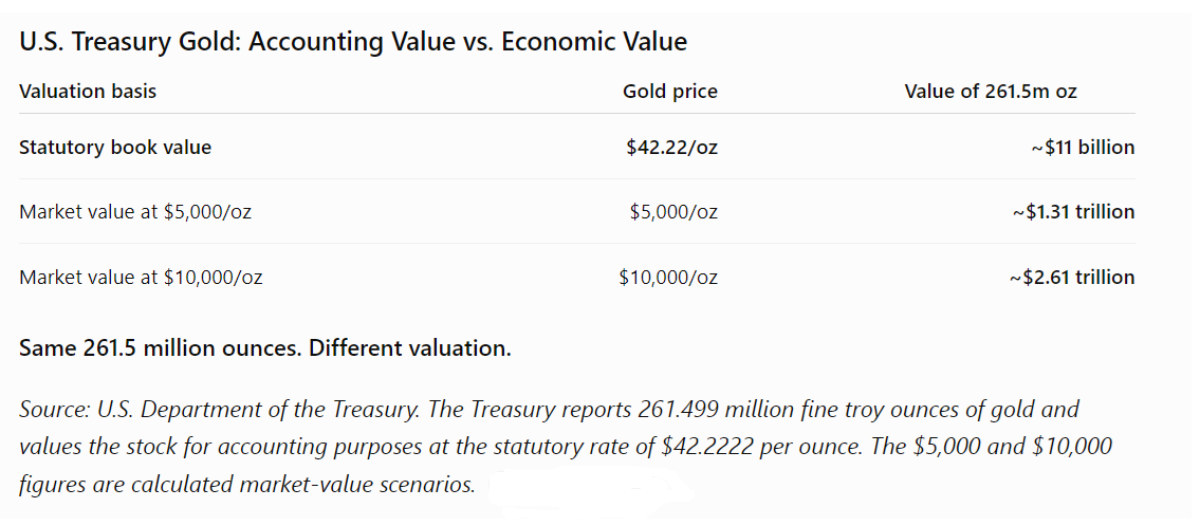
The Treasury’s books effectively treat an ounce of gold as worth $42.22, while the market treats the same ounce as worth nearly $5,000. At $5,000 an ounce, the Treasury’s existing gold stock would be worth about $1.31 trillion. At $10,000, it would be worth about $2.61 trillion. The government would not need to acquire another ounce for the economic value of its existing monetary gold to increase by another $1.3 trillion.
That makes the issue more than an accounting curiosity. Gold is already sitting on sovereign balance sheets as a monetary asset, and its market value can increase enormously without any change in the quantity held. In a world of enormous sovereign debt and increasingly constrained fiscal space, that creates an interesting political-economy question: at what point does the difference between the statutory value of official gold and its economic value become too large to ignore?
The physical argument ultimately comes back to a simple point. The world is not short of gold. It is short of gold that is simultaneously available, unencumbered, physically accessible and offered for sale. Mine supply is slow to respond, recycling only redistributes existing gold, and much of the above-ground stock is held by owners with little reason to sell.
The consequence is that the marginal tonne matters disproportionately. When strategic buyers enter the market seeking physical metal, they are competing not for all the gold that exists, but for the portion of that enormous stock that its owners are prepared to release. The price is the mechanism through which those owners are persuaded to sell.
4. The Private-Sector Awakening
While the official sector has begun the monetary rediscovery of gold, the private sector has barely begun to participate. This creates a potentially significant mismatch between the enormous pool of financial capital that could be allocated to gold and the limited supply available to absorb that demand.
The 2026 ‘In Gold We Trust’ report estimates global liquid financial assets to be approximately $321 trillion at the end of 2025, with gold accounting for just 2.7% of that total, compared with 46.5% in equities, 44.7% in bonds and 6.2% in alternative investments. The point is not that private investors should hold some particular “optimal” allocation to gold. It is that gold remains a very small component of an enormous pool of global financial wealth.
A 1% reallocation of $321 trillion would represent approximately $3.2 trillion. This is not a prediction that investors will suddenly move 1% of their portfolios into gold. It simply illustrates the scale of the capital pool relative to the size of the gold market. As we saw above, such demand cannot simply be met by newly mined gold and has to be met through a higher gold price in order to persuade existing owners to sell some of their above-ground gold holdings.
The potential sources of demand are also broader than conventional private investment portfolios. Sovereign wealth funds (SWFs) control enormous pools of capital and have historically allocated relatively little to gold compared with equities, bonds and other financial assets. Even a modest increase in strategic gold allocations across the SWF sector could therefore represent substantial increased demand. These institutions are particularly relevant because their investment horizons are often measured in decades rather than quarters, meaning gold acquired as a strategic asset may have a very different propensity to be sold from gold held by a short-term investor.
The emergence of large corporate holders of physical gold provides another indication of this changing institutional landscape. Tether, the issuer of USDT, has accumulated a substantial physical gold position, with its reported gold holdings reaching approximately 146 tonnes, and is a high profile example of a major non-state financial institution choosing to hold physical gold at a scale previously only associated with central banks and specialist bullion institutions.
This is not simply price exposure through a derivative or an unallocated account. It represents an institutional decision to own the underlying physical asset.
Commercial banks are another potential source of incremental gold demand. As the regulatory and institutional treatment of gold evolves, banks are reconsidering their role in physical precious-metals markets, and physical gold is increasingly being considered an institutional asset capable of sitting within the broader financial infrastructure.
This creates a potentially important feedback mechanism. Central banks, sovereign wealth funds and other strategic institutions acquire physical gold and tend to hold it for longer periods. Gold can therefore move from owners who are willing to sell when prices rise, into the hands of owners whose objective is to increase or maintain strategic gold reserves. The stock remains in existence, but the effective float can become progressively tighter.
That distinction matters because strategic accumulation is fundamentally different from the momentum-driven demand that characterised many previous gold cycles. A momentum investor buys because prices are rising and may sell when the trend reverses. A strategic buyer may be motivated by precisely the characteristics that make gold a monetary asset: its lack of an issuer, its lack of default risk, and its existence outside the liability structure of another sovereign entity.
Private investors, meanwhile, remain overwhelmingly concentrated in conventional financial assets. Equities and bonds dominate global portfolios because they generate income, provide liquidity and are deeply embedded in the existing financial architecture. Gold competes with these assets on a different basis. Gold’s attraction lies not in yield, but in scarcity, independence and the protection it can provide against risks embedded within the financial system itself.
If the monetary rediscovery of gold continues to spread from central banks into sovereign wealth funds, institutions and eventually private portfolios, the consequences could therefore be disproportionate to the apparent size of the allocation shift. A relatively small change in portfolio allocation can represent an enormous amount of capital competing for an asset whose annual supply is inherently limited and whose existing stock is already overwhelmingly owned.
And if the private sector eventually begins to treat gold not merely as a portfolio diversifier or inflation hedge, but as monetary insurance and an asset outside the liability structure of the conventional financial system, the resulting gold demand would represent something much larger than another investment cycle. It would represent a reallocation of global wealth. That is the mismatch at the heart of the next phase of the gold story.
5. The Repricing of Monetary Insurance
The current media narrative of a “gold bull market” focuses on the wrong metric. Describing the multi-year rise in the gold price as a “gold bull market” is like looking at a rising Richter scale and focusing on the number rather than the earthquake. The gold price is the measurement, but the deeper phenomenon is the changing confidence in the monetary system against which gold is being measured.
Nor is the monetary rediscovery of gold necessarily a bet on the end of the existing monetary system or the imminent demise of the US dollar. Governments will continue to hold Treasuries because they provide liquidity, income and a highly liquid home for dollar reserves. Dollars will continue to dominate global trade and financial markets. But strategic reserve management is not simply about maximising liquidity or return. It is also about what happens when the normal rules no longer function as expected.
That changes the question for investors. It is no longer simply “How much return can gold generate in my portfolio?” The more important question is “How much of my wealth should I hold in an asset that is not somebody else’s liability and does not depend on another sovereign to honour its value?”
And this question extends well beyond central banks. Sovereign wealth funds, institutional investors, commercial banks and private investors are all having to reconsider how much of their wealth should remain in financial claims, and how much should be held in an asset that stands outside the conventional financial system.
There are, of course, limits to how far this repricing can go. Higher prices will eventually weaken jewellery demand, increase recycling, encourage existing holders to sell and stimulate new mine supply. But the question is how high the price must rise before enough additional gold becomes available to meet the demand.
The strongest counterargument may be a sustained reduction in geopolitical risk. If tensions between major powers ease, conflicts end and confidence in the international financial system improves, some demand for monetary insurance could diminish. But the lesson of 2022 cannot be unlearned. Reserve managers have seen that foreign-currency assets held in another jurisdiction can be frozen. They may continue to hold dollars and euros, but the risk of relying on them exclusively can no longer be ignored.
Nor should instances of central banks selling gold invalidate the monetary thesis. A strategic reserve asset is valuable precisely because it can be mobilised when needed. An asset of last resort is supposed to be sold when the last resort arrives. The question is not whether central banks ever sell gold, but why they hold it in the first place and what role it plays when conventional financial assets become less reliable. None of these factors, however, answers the bigger question: what would be the market-clearing price of gold if the pool of investors seeking monetary insurance becomes substantially larger?
The important point is that remonetisation does not require a government to announce a new gold standard or formally restore gold to the centre of the monetary system. It can happen through behaviour. Central banks can increase their reserves. Sovereign wealth funds can allocate to physical gold. Governments can place greater emphasis on domestic gold custody. Financial institutions can reconsider the regulatory treatment of gold. Private investors can begin to regard gold not simply as a precious commodity, inflation hedge or portfolio diversifier, but as a monetary asset outside the liability structure of the conventional financial system.
That process is already visible in the composition of official reserve assets. In June 2026, the European Central Bank reported that, at market value, gold had overtaken US Treasuries as the largest component of global official reserves. At the end of 2025, gold accounted for approximately 27% of global official reserve assets, compared with approximately 22% for US Treasuries. This change reflects both continued official-sector accumulation and the dramatic increase in the market value of gold.
The bigger question is what happens if private investors start looking at gold in the same way that central banks already do, and decide that some of their portfolio wealth belongs in an asset that is nobody else’s liability. If that shift begins to happen on a meaningful scale, the result would be very different from a normal gold investment cycle. The gold price would be repricing gold’s monetary role and reflecting the higher value that the world’s largest holders of capital are placing on monetary independence.
The bull market is the symptom. The monetary rediscovery is the story.
Popular Blog Posts by Ronan Manly
 How Many Silver Bars Are in the LBMA's London Vaults?
 German Government Escalates War On Gold
 Polish Central Bank Airlifts 8,000 Gold Bars From London
 Quantum Leap as ABN AMRO Questions Gold Price Discovery
 How Militaries Use Gold Coins as Emergency Money
 JP Morgan's Nowak Charged With Rigging Precious Metals
 Hungary Announces 10-Fold Jump in Gold Reserves
 Planned in Advance by Central Banks: a 2020 System Reset
 Gold Is No One’s Liability – The Asset No One Can Print, Freeze or Default On