 Contact
 Help
Help





Is Platinum a Good Investment?
 Gold & Silver 101



Platinum has an unusual history among precious metals: for decades leading up to the 2008 financial crisis, it traded at a significant premium to gold, prized for its rarity and its heavy use in jewellery and diesel catalytic converters. Today, that relationship has reversed entirely — platinum now trades at well under half the price of gold, even as it retains genuine industrial demand and, unlike palladium, full tax-advantaged status in Singapore. That combination of historical prestige, current undervaluation, and real industrial utility makes platinum one of the more interesting precious metals to evaluate today.
So is platinum a good investment? In this guide, the team at BullionStar draws on years of experience in the precious metals market to answer that question, and explain exactly why.
Is Platinum a Good Investment? The Direct Answer
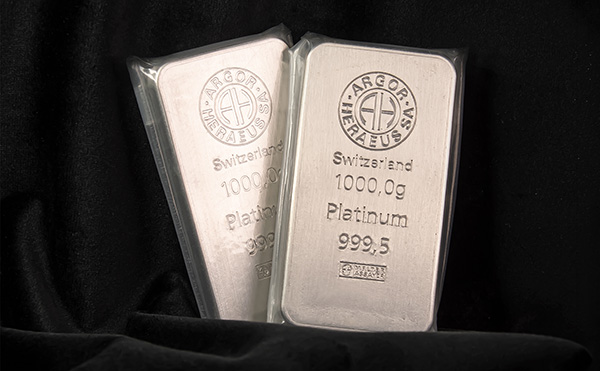
Yes, platinum can be a good investment, particularly for investors looking to diversify beyond gold and silver. It carries genuine caveats, with greater price volatility than gold and a smaller, less liquid market, but it also holds an advantage that palladium doesn’t. Platinum enjoys full Investment Precious Metal (IPM) status in Singapore, meaning qualifying platinum bars and platinum coins can be bought free of GST.
Whether platinum is still valuable today is really a question of perspective: its price has fallen well below gold’s after decades of trading at a premium, which some investors read as a genuine value opportunity, and others read as a reflection of platinum’s weaker safe-haven credentials.
Why Invest in Platinum?
There are several genuine reasons investors consider adding platinum to a portfolio:
- Portfolio Diversification — Platinum’s price is influenced by a different mix of factors to gold and silver, principally automotive and jewellery demand alongside a growing role in hydrogen fuel cell technology. That gives it a distinct risk profile worth considering for a diversified portfolio.
- Currently Undervalued Relative to Gold — Platinum traded at a significant premium to gold for decades before 2008, and today trades at under half of gold’s price. Some investors see this historic reversal as a sign platinum is undervalued relative to its long-term relationship with gold, though there’s no guarantee that relationship reasserts itself.
- Tax-Advantaged in Singapore — Unlike palladium, platinum qualifies as an Investment Precious Metal in Singapore, meaning it can be bought free of GST, a meaningful advantage for long-term investors.
- Diversified Industrial Demand — Platinum’s demand spans diesel vehicle catalytic converters, jewellery, and a growing hydrogen economy, giving it a broader industrial base than palladium’s near-total reliance on one application.
The Risks of Investing in Platinum
Platinum’s risks are worth weighing carefully alongside its potential:
- Higher Volatility Than Gold — Platinum’s smaller, thinner market means it tends to see sharper price swings than gold, particularly during periods of industrial or economic uncertainty.
- Smaller, Less Liquid Market — Trading volumes in platinum are considerably lower than gold or silver, which can mean wider spreads and less predictable pricing.
- Concentrated Supply — Around 75% of global platinum supply comes from South Africa alone, leaving the market exposed to disruptions from that single region.
- Structural Demand Uncertainty — Diesel vehicle demand has been in long-term decline in several major markets, and while hydrogen fuel cell technology offers a promising new source of demand, it remains a smaller, less proven market than the catalytic converter demand it may eventually replace.
Taken together, platinum suits investors comfortable with more volatility than gold in exchange for diversification, a currently favourable valuation, and the tax efficiency that palladium lacks.
Platinum vs Gold and Silver
Platinum sits in an unusual middle ground among the precious metals — sharing gold’s tax treatment in Singapore, some of silver’s industrial sensitivity, and palladium’s exposure to the automotive sector, while remaining genuinely distinct from all three. The table below summarises how the four metals compare, before we look at each comparison individually.
| Metal | Primary Demand Driver | Volatility | Supply Concentration | Singapore Tax Status |
|---|---|---|---|---|
| Platinum | Automotive & industrial (~63%), jewellery (~28%) | High | Concentrated (~75% South Africa) | IPM — GST-exempt, no CGT |
| Gold | Investment (~44%), jewellery, central banks; industrial ~6% | Low–Medium | Globally diversified | IPM — GST-exempt, no CGT |
| Silver | Dual: monetary + industrial (solar, electronics) | Medium–High | Globally diversified | IPM — GST-exempt, no CGT |
| Palladium | ~80% industrial (catalytic converters) | Very High | Concentrated (Russia, South Africa) | Not IPM — GST applies |
Platinum Vs Gold
Platinum and gold have an unusually inverted relationship. In the run-up to the 2008 financial crisis, platinum traded at a substantial premium to gold. At times platinum was more than US$2,000 above gold’s price per ounce, reflecting its rarity and heavy use in jewellery and diesel vehicle catalytic converters.
That relationship has since reversed entirely: platinum now trades at well under half the price of gold, a shift driven by several factors. Diesel vehicle demand has declined structurally across major markets, and for years automakers substituted palladium for platinum in autocatalyst loadings whenever platinum carried a price premium — permanently reducing the amount of platinum used per vehicle, even where diesel volumes held up. Gold’s own surge, as investors turned to it as a monetary safe-haven asset, widened the gap further from the other side.
The two metals are also driven by fundamentally different demand. Around 63% of platinum demand comes from automotive and broader industrial applications, compared to roughly 6% for gold, whose demand is dominated by investment (around 44%), gold jewellery, and central bank buying. That makes platinum’s price far more sensitive to industrial and economic cycles, while gold responds more to inflation, currency, and safe-haven flows.
Is platinum better than gold? For most investors building a core, long-term holding, no — gold’s stability, deep liquidity, and unmatched track record as a store of value make it the first choice of precious metal for investment. But platinum’s current discount relative to its historical relationship with gold, combined with its distinct industrial demand profile, makes it a reasonable complementary holding for investors who understand its added volatility and want a different kind of exposure.
Platinum Vs Silver
Platinum and silver share more in common with each other than either does with gold: both carry significant industrial demand, both trade at a fraction of gold’s price, and both are more volatile as a result.
The key difference is where that industrial demand comes from — silver’s is spread across solar panels, electronics, and medical applications, while platinum’s centres on automotive catalytic converters, jewellery, and a growing role in hydrogen fuel cells. Silver also benefits from a larger, more liquid market and stronger monetary demand as a historic store of value, while platinum’s investment case rests more heavily on its industrial applications and its current price discount relative to gold.
Platinum Vs Palladium
Platinum and palladium are the closest comparison of any two metals in this guide — both are platinum-group metals used primarily in catalytic converters, both come predominantly from South Africa and Russia, and both are far more volatile than gold or silver. The key difference is application: platinum is more common in diesel vehicles and carries a growing role in hydrogen fuel cell technology, while palladium is used almost exclusively in petrol and hybrid vehicle catalytic converters.
Platinum also holds a meaningful advantage that palladium lacks — Investment Precious Metal (IPM) status in Singapore, meaning it can be bought free of GST. For investors deciding between the two, platinum’s broader demand base and favourable tax treatment generally make it the easier metal to justify, though palladium can offer sharper short-term moves for those willing to accept the added risk. View our full guide on Is Palladium a Good Investment? for more information on this alternative precious metal.
Platinum Performance, Demand, and Supply Dynamics
Understanding what actually moves the platinum price requires looking at both sides of the equation: a demand base that’s more industrial than gold’s, and a supply chain that has struggled to keep pace for several years running.
Platinum Demand
Platinum demand splits across four main categories: automotive (around 39%), industrial applications (around 24%), jewellery (around 28%), and investment (around 9%). The automotive share comes overwhelmingly from diesel vehicle catalytic converters, a segment that has faced long-term decline in several major markets as diesel’s popularity wanes. Offsetting that, platinum is increasingly used in hydrogen fuel cell technology, both in fuel cells themselves and in electrolysers used to produce hydrogen. These fuel cells represent a genuinely new and growing source of demand that didn’t meaningfully exist a decade ago.
Platinum Supply
Around 75% of the world’s platinum is mined in South Africa, with Russia and Zimbabwe making up most of the remainder. South African output has been in long-term decline, falling from roughly 5.3 million ounces in 2006 to around 3.9 million ounces in 2025 — a 26% reduction driven by ageing mines, power disruptions, and rising production costs. Recycling from scrapped catalytic converters and jewellery adds meaningful secondary supply, though it hasn’t been enough to offset the shortfall.
That combination has pushed the platinum market into a structural deficit for four consecutive years, with the World Platinum Investment Council reporting a shortfall of roughly 1.08 million ounces in 2025 and above-ground inventories now covering only around four months of demand. The deficit is forecast to narrow in 2026, but supply is expected to remain tight.
Platinum Price Performance and Returns
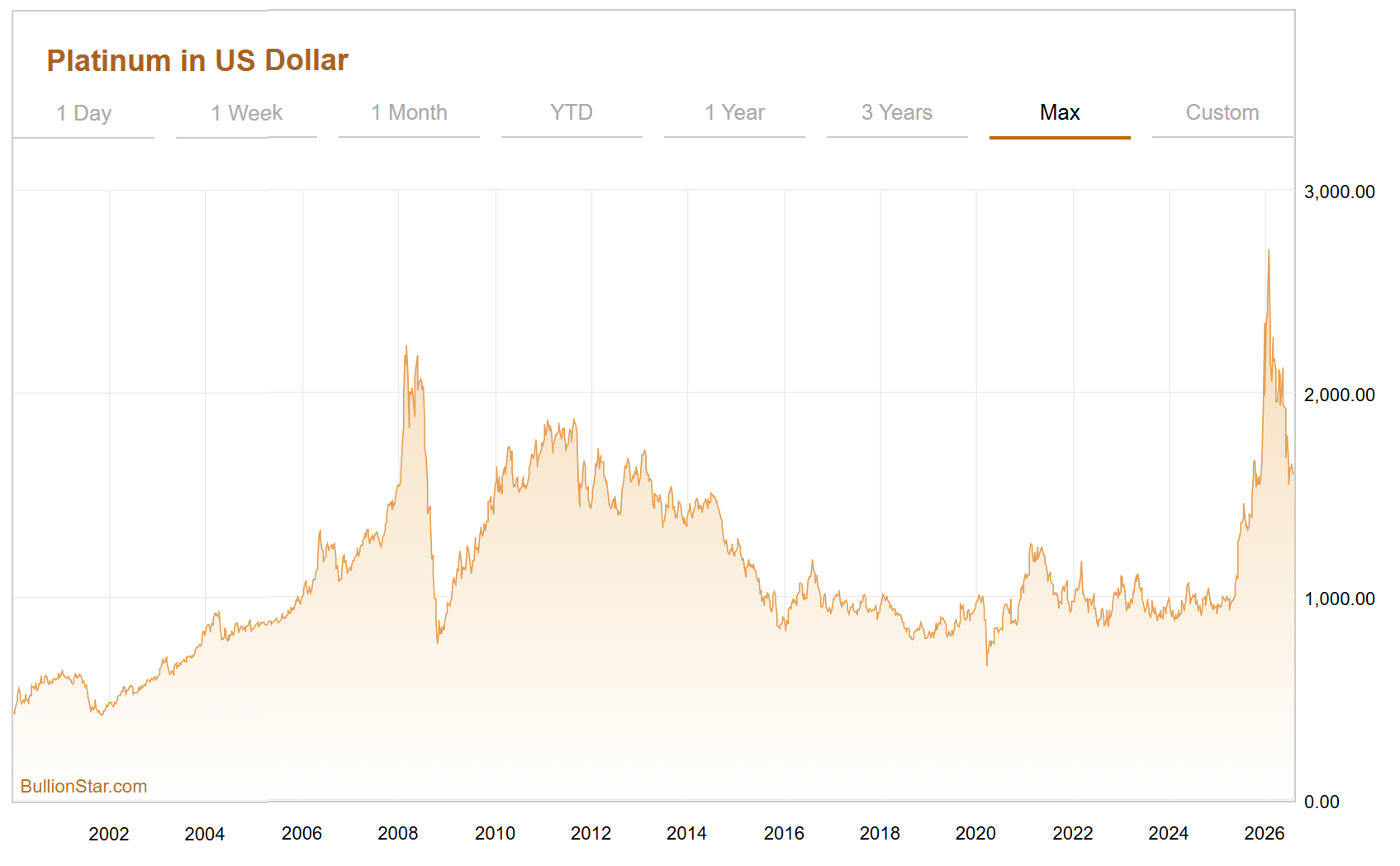
Platinum’s price history shows the same boom-and-bust character as its platinum-group cousin, palladium, though its most recent cycle has been even more dramatic. After decades trading below its old 2008 record of around US$2,290 per ounce, platinum surged through 2025 and into early 2026, driven by Chinese jewellers rotating into platinum at a record discount to gold, tightening exchange stockpiles amid US trade policy uncertainty, and a broader wave of bullish sentiment across precious metals. That rally culminated in a new all-time high of US$2,923 per ounce on 26 January 2026, before correcting sharply in the final days of January and settling back above US$2,000 per ounce in early February. Platinum has since eased further, currently trading around US$1,600–1,665 per ounce — well below its new peak, but still a meaningfully higher base than the metal traded at for most of the prior decade.
Platinum Outlook
Platinum’s own research body, the World Platinum Investment Council, argues the fundamentals behind its 2026 rally haven’t gone away even after the price pulled back. The market has run consecutive supply deficits since 2023, and while 2026 is forecast to be closer to balanced, that isn’t expected to meaningfully ease current tightness — elevated lease rates and strong backwardation in the physical market both point to a genuine shortage of available metal.
Growing hydrogen fuel cell demand adds a further structural tailwind, and platinum’s price remains significantly below gold’s despite the recent rally, a gap some investors see as room for further catch-up. The main offsetting risk is on the demand side: tariffs and trade policy uncertainty could weigh on industrial demand, and any slowdown in Chinese investment appetite (a key driver of the 2025–2026 rally) would remove one of the main pillars behind platinum’s outlook.
How to Invest in Platinum (Bars, Coins, ETFs)
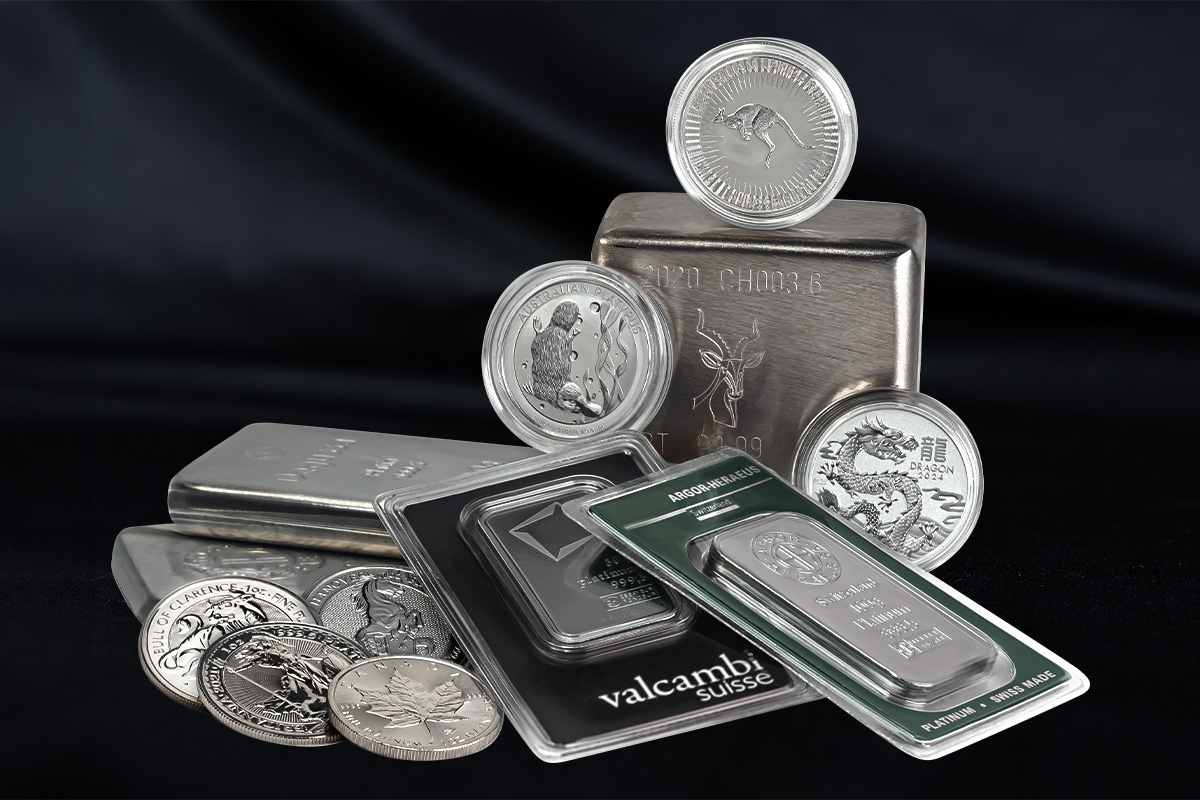
There are three main ways to gain exposure to platinum: physical bullion, exchange-traded funds (ETFs), and mining company shares. Physical platinum bars and platinum coins offer direct ownership with no counterparty risk, and many national mints produce platinum versions of their flagship bullion coins including the Kangaroo, Maple Leaf and Britannia. Buying platinum this way means paying a premium over the spot price, but you hold the metal itself, free of any reliance on a third party, and can benefit from Singapore’s IPM tax exemptions.
Platinum ETFs and other paper products offer lower-cost exposure to the price without the need for storage, but they come with counterparty risk and don’t provide the same protection during a banking or financial crisis that physical ownership does. Mining stocks offer a different kind of exposure altogether — leveraged to the platinum price, but also exposed to company-specific risks like operational costs, labour disputes, and country risk, particularly given how concentrated platinum mining is in South Africa.
For most investors seeking genuine diversification and a hedge against financial system risk, physical platinum bullion is the more straightforward choice. We cover the full comparison of bars, coins, ETFs, and mining stocks, along with how to choose between them, in our dedicated How to Invest in Platinum guide.
Frequently Asked Questions
Is platinum a better investment than gold?
For most investors building a core, long-term holding, no — gold’s stability, deeper liquidity, and unmatched track record as a monetary safe-haven asset make it the more reliable choice for the majority of a precious metals allocation. Platinum can be a good complementary holding, especially given its current price gap to gold and its exposure to structural industrial demand, but it comes with meaningfully higher volatility and a smaller, thinner market. The better question for most investors isn’t “platinum or gold" but how much of each to hold alongside one another.
Why is platinum cheaper than gold now?
Platinum trades well below gold today because the two metals are driven by very different forces. Gold’s price has surged on strong central bank demand, and safe-haven buying amid inflation and geopolitical uncertainty. Platinum, by contrast, is roughly two-thirds driven by industrial and automotive demand, which has faced headwinds from declining diesel vehicle use. Platinum did stage its own dramatic rally in 2025 and into 2026, briefly hitting a new all-time high of US$2,923 per ounce in January 2026, but even after that surge it remains significantly below gold’s price — a gap some investors see as a sign platinum is undervalued relative to its historical relationship with gold.
What’s the platinum outlook for 2026?
The platinum outlook for 2026 is constructive, underpinned by a fourth consecutive year of market deficit, even though the shortfall is expected to narrow compared to 2025. Elevated lease rates and strong backwardation in the physical market both point to a genuine, ongoing shortage of available metal, and growing hydrogen fuel cell demand adds a structural tailwind that didn’t exist in previous cycles. The main risks are a slowdown in Chinese investment demand, and trade policy uncertainty weighing on industrial demand. On balance, tight supply and platinum’s continued discount to gold support a positive medium-term outlook.
Is platinum jewellery a good investment?
Platinum jewellery can hold value well due to the metal’s durability and purity, but it is generally not an efficient way to invest in platinum. Jewellery carries substantial retail markups for design and craftsmanship that aren’t recovered on resale, and its value is judged on style and brand as much as metal content. Investors seeking genuine exposure to the platinum price are better served by investment-grade bars and coins, which trade close to the underlying spot price, have tax advantages in some jurisdictions, and can be resold without the same markup loss.
How much platinum should I hold in my portfolio?
Given its higher volatility and industrial demand sensitivity, platinum is generally best held as a smaller, complementary position rather than a core allocation — typically in the range of 2–5% of a portfolio, alongside a larger holding in gold and/or silver. Investors comfortable with more volatility, or specifically seeking exposure to industrial and hydrogen-economy demand trends, may weight platinum more heavily, but it shouldn’t replace gold’s role as the foundation of a precious metals allocation.
Platinum or palladium: which should I buy?
For most investors, platinum is the more balanced choice between the two sister metals. It carries Investment Precious Metal (IPM) status in Singapore, unlike palladium, and its demand is spread across a broader base rather than being almost entirely reliant on catalytic converters. Palladium can still appeal to investors specifically seeking exposure to petrol vehicle demand dynamics, but platinum is generally the easier metal to justify from both a cost and tax perspective.
Is Platinum a Good Investment? The Bottom Line
Platinum earns its place in a well-diversified portfolio, but as a complement to gold and silver rather than a replacement for either. Its industrial demand base, structural supply deficit, and current discount to gold give it a genuinely different risk and return profile — and unlike palladium, it retains full tax-advantaged status in Singapore, making it a more straightforward metal to hold long-term. That said, platinum’s higher volatility and smaller, thinner market mean it demands a level of comfort with price swings that gold investors don’t typically need.
For investors willing to accept that volatility, platinum’s recent history — surging to a new all-time high of US$2,923 per ounce in January 2026 before pulling back sharply — is a reminder of both its upside potential and the risks that come with it. Approached as a smaller, deliberate allocation alongside a core gold and silver holding, platinum can add genuine diversification without derailing a long-term investment plan.
Ready to add platinum to your portfolio? Browse our platinum range, track live prices with our price charts, or get in touch with our team at support@bullionstar.com — we’re happy to help.
Popular Blog Posts by Gold & Silver 101
 An Introduction to Gold & Silver Investing
 Should I Invest in Gold, Silver, or Platinum Bullion?
 Gold Coins vs Gold Bars: Which Is Better?
 How Is Gold Taxed in Singapore? The IPM GST Exemption Explained
 Storing Precious Metals, Gold, and Silver Bullion
 Gold & Silver Bullion Investing FAQs
 999 Fine Silver: Investment-Grade Silver Explained
 Gold Savings Account vs Bullion Savings
 Silver Purity: The Complete Guide
 How to Invest in Silver: A Complete Guide