 Contact
 Help
Help





Portfolio Diversification: A Complete Guide
 Gold & Silver 101



Every investment portfolio carries risk. Managing that risk is in the investor’s interest, and one way to do it is through diversification, which spreads risk across assets that don’t all move in the same direction at the same time.
Done well, a diversified portfolio can reduce the impact of any single market downturn on your overall wealth, smooth returns over time, and give you exposure to growth across multiple asset classes without the volatility of concentrating everything in one place.

This guide covers what portfolio diversification is, how to build a diversified portfolio step by step, how to think about asset allocation across stocks, bonds, real estate and gold, and how to manage and rebalance your portfolio over time. BullionStar has been helping investors diversify their portfolios with physical precious metals since 2012, and we firmly believe gold and silver earn their place in any well-diversified portfolio.
Please note that BullionStar does not provide investment or financial advice. The information below is for informational purposes only. Your individual circumstances and goals will always be the most important factors in any investment decision.
What Is Portfolio Diversification?
Portfolio diversification is the practice of spreading investments across different asset classes, geographies and sectors so that the poor performance of any single holding has a limited impact on your overall wealth. The underlying principle is simple: assets that respond differently to the same economic conditions will not all fall at the same time.
The concept is often summarised as “don’t put all your eggs in one basket" — but in investment terms, it goes further than that. True diversification is not just about owning many different things. It is about owning things that are genuinely uncorrelated. This means assets whose prices move independently of each other, or better still, move in opposite directions under the same conditions.
What Is a Diversified Portfolio?
A diversified portfolio typically holds a variety of asset classes, such as equities, bonds, cash, and real assets such as property or commodities. This mix of assets is weighted according to the investor’s time horizon, risk tolerance and financial goals.
The exact composition varies, but the objective is consistent: to balance the potential for growth against the need to manage downside risk. Adding real assets such as gold introduces an additional layer of protection — particularly during periods of inflation or financial stress, when both equities and bonds can struggle simultaneously.
The Benefits of Diversification
The core benefits of a well-diversified portfolio are:
- Reduced volatility. Losses in one asset class are offset, at least partially, by stability or gains in another.
- Smoother long-term returns. Diversification tends to reduce the severity of drawdowns, making it easier to stay invested through difficult periods.
- Protection against concentration risk. A single stock, sector or country can collapse. A diversified portfolio is not dependent on any one outcome.
- Exposure to multiple growth drivers. Different asset classes perform well under different economic conditions — diversification ensures you participate in more of them.
How to Diversify Your Portfolio (Step-by-Step)
Building a diversified portfolio is not a single decision, it is a process. The five steps below provide a practical framework for assessing where you are, identifying gaps, and constructing a portfolio that spreads risk meaningfully across asset classes.
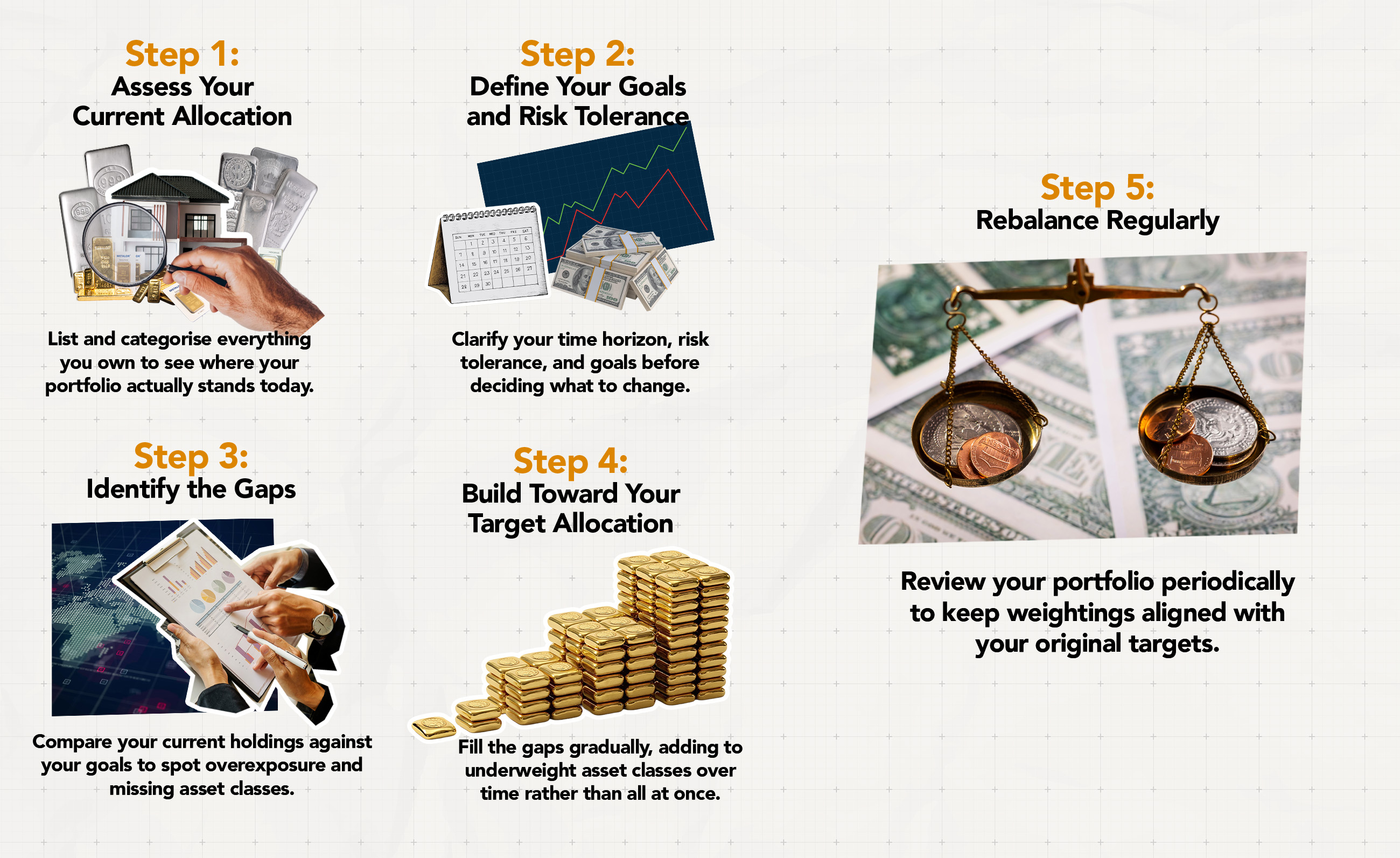
Step 1: Assess Your Current Allocation
Before making any changes, understand what you already own. List all of your assets across all accounts and categorise each by asset class — equities, bonds, cash, property, commodities, precious metals. Calculate the percentage weight of each category relative to your total portfolio.
Many investors who consider themselves diversified find at this stage that they are heavily concentrated in one or two asset classes, with limited exposure to real assets or genuine inflation hedges.
Step 2: Define Your Goals and Risk Tolerance
Diversification looks different depending on your circumstances. A 30-year-old building long-term wealth will hold a different portfolio to a retiree prioritising capital preservation. Before deciding what to add or remove, be clear on:
- Time horizon — how long before you may need to access the funds
- Risk tolerance — how much short-term volatility you are comfortable absorbing without making reactive decisions
- Goals — growth, income, wealth preservation, or a combination
These factors determine the appropriate weighting between higher-risk growth assets and lower-risk, more stable holdings.
Step 3: Identify the Gaps
With your current allocation mapped and your goals defined, compare the two. Common gaps include:
- Overexposure to a single country or region — particularly home market bias, where investors hold a disproportionate share of domestic assets
- No inflation hedge — portfolios heavy in cash and nominal bonds are vulnerable to sustained inflation eroding purchasing power
- No real assets — equities and bonds are both financial instruments; portfolios without property, commodities or precious metals lack exposure to tangible assets that behave differently in a crisis
Step 4: Build Toward Your Target Allocation
Once gaps are identified, fill them systematically rather than all at once. Investing gradually, and adding to underweight asset classes over time, reduces the risk of poor market timing on any single entry point.
For many investors, a 5–15% allocation to physical gold is a practical starting point for real asset exposure. This provides an inflation hedge and a non-correlated asset that holds value independently of equity markets.
Step 5: Rebalance Regularly
A diversified portfolio does not stay diversified without maintenance. As asset prices move, weightings drift — equities that perform strongly will grow to represent a larger share of the portfolio than intended, increasing concentration risk.
A disciplined portfolio rebalancing strategy means reviewing at least annually, or when any asset class drifts significantly from its target weight, and keeps the portfolio aligned with your original goals.
Asset Allocation by Class (Stocks, Bonds, Real Estate, Gold)
A diversified portfolio draws from multiple asset classes, each with a distinct risk profile, return driver and role in the overall mix. The table below summarises the main asset classes and how they behave, followed by a closer look at each.
| Asset Class | Role in Portfolio | Key Risk | Correlation to Equities |
|---|---|---|---|
| Equities | Growth | Market volatility, company risk | High |
| Bonds | Stability, income | Interest rate risk, inflation, default | Low to moderate |
| Real Estate | Income, inflation hedge | Illiquidity, leverage risk | Moderate |
| Gold & Silver | Crisis hedge, inflation protection | Price movement | Low to negative |
| Cash | Liquidity buffer | Inflation erosion | None |
Equities
Equities (stocks or shares in publicly listed companies) are the primary growth engine of most portfolios. They can outperform other asset classes during bull markets, but they come with significant short-term volatility. Individual stocks carry company-specific risk; even broad index funds are exposed to market-wide drawdowns during recessions or financial crises.
Bonds
Government and investment-grade corporate bonds provide income and stability. They have historically moved inversely to equities in risk-off environments — when investors sell shares and seek safety, bond prices rise.
However, the 2022 environment, when both equities and bonds fell sharply as central banks raised interest rates aggressively, exposed the limitations of relying on this relationship. Bonds provide a useful stabiliser, but they are not a reliable crisis hedge in all conditions, particularly when inflation is the primary risk.
A longer-term concern is sovereign default risk. As global debt approaches $353 trillion the assumption that government bonds are a risk-free asset deserves scrutiny. Debt-to-GDP ratios across major economies continue to rise, and the trajectory raises legitimate questions about long-term fiscal sustainability. Investors who hold significant bond allocations as their primary safe-haven position may find that, in a severe sovereign debt crisis, the assumed safety of that position does not hold.
Real Estate
Property provides long-term capital growth, potential rental income, and a degree of inflation protection — rents and property values tend to rise over time alongside the general price level. Real estate also has a moderate correlation to equities, providing partial diversification benefit.
The main drawbacks are illiquidity (property cannot be sold quickly in a crisis), and the leverage typically required to hold it, which amplifies both gains and losses.
Gold and Silver
Gold and silver occupy a unique position in a diversified portfolio. Unlike equities and bonds, they are tangible assets with no counterparty risk — their value is not contingent on any issuer, government or financial institution. This independence is precisely what makes them valuable when the financial system comes under stress. Gold reserves are held by central banks around the world for the same benefits.
Gold in particular has a long track record of low to negative correlation with equities. The gold price tends to rise when investor confidence falls, when inflation erodes the purchasing power of fiat currencies, and when geopolitical uncertainty drives demand for safe-haven assets. The result is an asset that can provide meaningful protection precisely when the rest of a conventional portfolio is under pressure.
Silver shares many of gold’s monetary and safe-haven characteristics, while also having significant industrial demand, which can drive additional upside during periods of economic expansion.
Cash
Cash and cash equivalents (savings accounts, money market funds, and short-term deposits) provide liquidity and stability. As the primary unit of trade globally, holding at least some cash is essential for any investor. Cash ensures you can meet short-term obligations or take advantage of investment opportunities without being forced to sell other assets at an unfavourable time.
The risk of holding too much cash is inflation erosion: in a sustained inflationary environment, the real purchasing power of cash declines steadily. Cash is best treated as a liquidity buffer rather than a long-term investment allocation.
The 60/40 Portfolio and Modern Alternatives
The traditional 60/40 portfolio (60% equities, 40% bonds) was the standard framework for balanced investing for decades. Its limitations have become more apparent in recent years, prompting investors and advisers to consider portfolio models that incorporate a broader range of asset classes.
Two well-regarded alternatives are worth noting:
Ray Dalio’s All Weather Portfolio is designed to perform across all economic environments — growth, recession, inflation and deflation. It allocates roughly 30% to equities, 40% to long-term bonds, 15% to intermediate bonds, 7.5% to gold and 7.5% to commodities.
Harry Browne’s Permanent Portfolio takes a simpler approach: 25% each in equities, long-term bonds, cash and gold. Each quarter of the portfolio is designed to thrive in one of four economic conditions (prosperity, recession, inflation and deflation), with gold specifically covering the inflationary scenario.
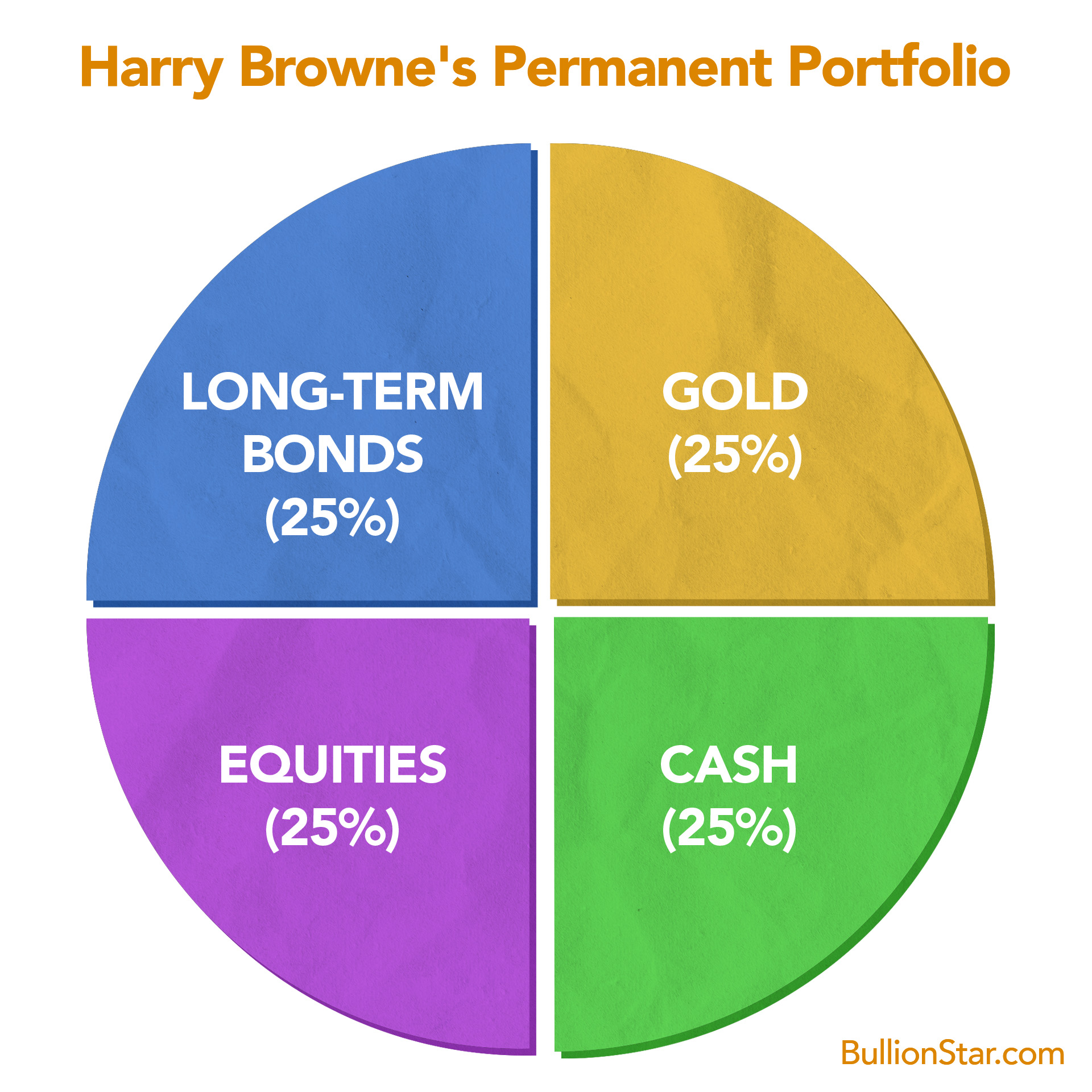
Both models are worth studying not as prescriptions but as frameworks. They illustrate how experienced investors think about building portfolios that are genuinely resilient across different economic conditions, rather than optimised for a single environment.
Gold’s Role in Portfolio Diversification
Of all the asset classes available to investors, gold occupies a genuinely distinctive position in portfolio risk management. It is not a financial instrument. It carries no counterparty risk. It cannot default, be inflated away by a central bank, or lose its value because an institution fails. These characteristics, combined with a long track record of low to negative correlation with equities, are why gold has been held as a portfolio anchor by central banks, sovereign wealth funds and long-term investors for centuries.
Why Gold Is an Uncorrelated Asset
Correlation measures how closely two assets move together. A correlation of +1 means they move in perfect lockstep; a correlation of -1 means they move in exactly opposite directions; 0 means no relationship at all.
Gold’s correlation to equities has historically been low to negative — particularly during market crises, when the relationship tends to strengthen in gold’s favour. When equity markets fell sharply in 2008, gold held its value and subsequently rose over the following three years. When the Covid-19 shock hit in early 2020, gold reached new all-time highs within months.
This behaviour is not coincidental. Gold tends to rise as confidence in financial institutions and fiat currencies falls, which are precisely the conditions under which most other assets struggle. It is this counter-cyclical character that makes it valuable not just as an investment, but as a genuine diversifier.
How Much Gold Should You Hold in a Portfolio?
There is no universal answer, but the academic and practitioner consensus clusters around a 5–10% allocation for most investors, with some models going higher. For investors with a specific concern about inflation, sovereign debt risk or currency debasement, a higher allocation (up to 15% or more) may be appropriate. For a more detailed breakdown of how to size a precious metals allocation relative to your overall portfolio, see our guide to Gold and Silver Portfolio Allocation.

Silver’s Role Alongside Gold
Silver shares gold’s monetary characteristics — it has historically served as money, it carries no counterparty risk, and it tends to perform well in inflationary environments. It also benefits from substantial industrial demand in solar energy, electric vehicles and general electronics, which can provide additional upside during periods of economic expansion.
Silver is more volatile than gold however, and the price of silver tends to move more sharply in both directions. For investors who already hold gold and want to increase their precious metals allocation, silver offers complementary exposure with a different return profile. A common approach is to hold gold as the primary allocation and silver as a secondary position, typically at a smaller weighting given its higher volatility.
Physical Gold vs Paper Gold for Portfolio Diversification
Not all gold exposure is equal from a diversification standpoint. Gold ETFs, futures and other paper instruments track the gold price, but they introduce counterparty risk — the very risk that gold’s role in a portfolio is designed to eliminate. In a systemic financial crisis, the protective qualities of physical gold are most needed, and paper gold instruments are exposed to the institutional risks that triggered the crisis.
Physical gold held directly, or in allocated vault storage, is the format that delivers the full diversification benefit. It sits outside the financial system, cannot be defaulted on, and maintains its value independently of any institution’s solvency. For a detailed comparison of the structural differences between physical and paper gold, see our guide to Why Physical Gold & Silver Beats Paper.
Geographic Diversification: The Case for Storing Gold in Singapore
Diversification applies not just to asset classes but to jurisdictions. Holding all of your assets in a single country exposes you to the political, regulatory and fiscal risks of that jurisdiction. Spreading holdings across stable, well-regulated jurisdictions reduces this risk.
Singapore is widely regarded as one of the world’s most secure locations for holding physical gold and silver. It offers political stability, a robust rule of law, no capital gains tax on physical precious metals, and GST exemption on qualifying Investment Precious Metals (IPM). As a global financial centre with a long track record of respecting property rights, it provides a reliable and transparent environment for long-term wealth storage.
BullionStar’s vault storage in Singapore allows investors to hold fully allocated physical gold and silver in their own name, and outside their home financial system. For investors considering offshore storage as part of a broader diversification strategy, our Offshore Gold Storage guide covers the key considerations in detail.

Frequently Asked Questions
Why diversify my portfolio?
Diversification reduces the impact of any single asset or market declining sharply on your overall wealth. A concentrated portfolio that is heavy in one asset class, sector or geography, is exposed to a single set of risks. A diversified portfolio spreads that exposure, smoothing returns over time and reducing the likelihood of a permanent, unrecoverable loss.
Should I add gold to my diversified portfolio?
For most investors, yes. Gold has a long track record of low to negative correlation with equities, making it one of the few assets that tends to hold or increase its value when conventional portfolios are under pressure. A 5–10% allocation to physical gold is a practical starting point — enough to provide meaningful protection without significantly diluting growth potential. For a detailed breakdown, see our guide to Gold and Silver Portfolio Allocation.
What’s a typical asset allocation for diversification?
There is no single correct answer — allocation depends on your time horizon, risk tolerance and goals. Modern allocations such as Ray Dalio’s All Weather Portfolio and Harry Browne’s Permanent Portfolio incorporate real assets including gold to provide robust protection across different economic conditions.
How often should I rebalance?
For most long-term investors, an annual review is sufficient. A threshold-based approach to rebalancing whenever any asset class drifts more than 5–10% from its target weight can be used alongside or instead of a fixed schedule. The key is consistency: rebalancing should be a planned discipline, not a reaction to short-term market movements.
Is real estate good for diversification?
Yes, real estate provides long-term capital growth, potential rental income and partial inflation protection, with moderate correlation to equities. The main drawbacks are illiquidity and the leverage typically required. REITs offer a more accessible alternative, though they trade on stock exchanges and tend to behave more like equities during market stress — reducing their diversification benefit at precisely the moment it is most needed.
Start Building a More Resilient Portfolio
Diversification is not a single decision, it is an ongoing discipline. The investors who weather financial crises, inflationary periods and market dislocations most effectively are not those who predicted them, but those who built portfolios that did not depend on any single outcome going right.
Physical gold and silver have earned their place in any diversified portfolio. They are tangible, counterparty-free assets with a centuries-long track record of preserving wealth across every monetary system and financial crisis the modern era has produced. For Singapore-based investors, the additional advantages of GST exemption, zero capital gains tax and access to one of the world’s most secure and well-regulated storage environments make the case stronger still.
BullionStar has been helping investors hold physical precious metals since 2012 — through vault storage in Singapore, a full range of gold and silver bars and coins, and the Bullion Savings Program for investors who want to start small and build gradually. Browse our gold range or learn more about vault storage to take the next step.
Popular Blog Posts by Gold & Silver 101
 An Introduction to Gold & Silver Investing
 Should I Invest in Gold, Silver, or Platinum Bullion?
 Gold Coins vs Gold Bars: Which Is Better?
 How Is Gold Taxed in Singapore? The IPM GST Exemption Explained
 Storing Precious Metals, Gold, and Silver Bullion
 Gold & Silver Bullion Investing FAQs
 Karat vs Carat: What’s the Difference?
 Gold Purity: The Complete Guide
 How Much Gold Is There in the World?
 Junk Silver: What It Is and What It’s Worth