 Contact
 Help
Help






Gold Saving vs Gold Investing: What's the Difference?

 BullionStar
 3 Comments



Ask most people whether they’re “saving" in gold or “investing" in it, and you’ll likely get a shrug. Isn’t that the same thing? It isn’t, and the difference matters more than it sounds. Saving is what you do with money you want to protect: setting it aside, regularly, with preserving its value as the goal. Investing is what you do with money you’re willing to put at risk in pursuit of a return. Gold can serve either purpose, but most people buying physical gold today are doing the first one, even if they call it “investing" out of habit.
Put simply: earn and spend in currency, but save in something a currency can’t quietly erode.
That distinction is exactly why gold keeps getting compared to something as ordinary as cash in a savings account. Both look, on the surface, like simply putting money aside. But a savings account pays interest in a currency that quietly loses purchasing power every year, while gold saving pays no interest at all and instead holds its value against that same loss. Which one actually leaves you better off after ten, or twenty, years isn’t a matter of opinion — it’s a question with a real, data-backed answer.
This guide draws a clear line between saving in gold and investing in gold, puts gold head-to-head against cash and savings accounts using two decades of real price and interest rate data, walks through the practical mechanics of saving in gold regularly, and covers what it costs to do so. If you’ve already decided gold deserves a place in your portfolio and want the full investment case instead, our How to Invest in Gold: A Complete Guide covers that ground.
Please note that BullionStar does not provide investment or financial advice. The information below is for informational purposes only. Your individual circumstances and goals will always be the most important factors in any investment decision.

Saving in Gold vs Investing in Gold: The Difference
Most of the confusion between saving in gold and investing in gold comes down to a single fact: gold pays no yield. There’s no interest, no dividend, and no coupon; whatever return gold generates comes entirely from a change in its price. That single feature is why gold saving is the right way to think about gold for most people, and gold investing only for some.
Saving in gold means building a position gradually, often the same amount at the same interval, with preserving value as the goal rather than beating the market. It’s the same instinct behind putting money into a savings account each payday, just directed at an asset that can’t be printed or devalued by monetary policy instead of one that can. Gold savings built this way aren’t judged month to month; they’re judged over years, against how much purchasing power they’ve protected.
It’s also not a new idea. Families, institutions, and even central banks have used exactly this approach for generations, holding gold as a store of wealth across decades rather than trying to beat a market with it, long before anyone was charting 20-year returns.
Investing in gold is a different exercise. It means taking a deliberate position, often a lump sum or a larger allocation decided on all at once, with an actual return as the objective and a willingness to be wrong about timing. An investor is watching the gold price the way they’d watch any other asset: looking for entry points, sizing a position, and measuring success against a benchmark.
| Saving in Gold | Investing in Gold | |
|---|---|---|
| Goal | Preserve purchasing power | Generate a return |
| How it’s built | Regular, smaller purchases over time | A deliberate, often larger position |
| Time horizon | Years to decades | Set by the investment thesis |
| Success looks like | Value protected against inflation and currency debasement | Price appreciation against a benchmark |
| Right approach | Dollar-cost averaging / recurring purchase plan | Timed allocation sized to a portfolio |
Neither approach is more “correct" than the other, but most people asking whether they should buy gold are really asking a saving question, not an investing one. Should I be putting some of my money into something that can’t be printed or defaulted on, instead of leaving all of it in cash? If that’s the question you’re asking, BullionStar’s Bullion Savings Programme combined with AutoInvest is built specifically for it. Combined, they provide a way to save in gold in fixed, regular amounts without needing to time the market or manage a position.
Gold vs Cash and Savings Accounts
This is really the question underneath everything else on this page: is gold better than cash, or is your money safer sitting in a savings account earning interest? The honest answer is that it depends entirely on the period you look at, so rather than argue it in the abstract, it’s worth looking at what actually happened over the last 20 years.
In August 2006, $632.59 bought one troy ounce of gold. That same $632.59, left in a savings account instead, would have earned interest every year since. Twenty years on, here’s where each ended up:
$632.59 in physical gold in August 2006 is worth $4,160 today, a 558% total return. The same $632.59 left in a high-yield savings account, earning interest the whole way, is worth $965, a 53% total return.
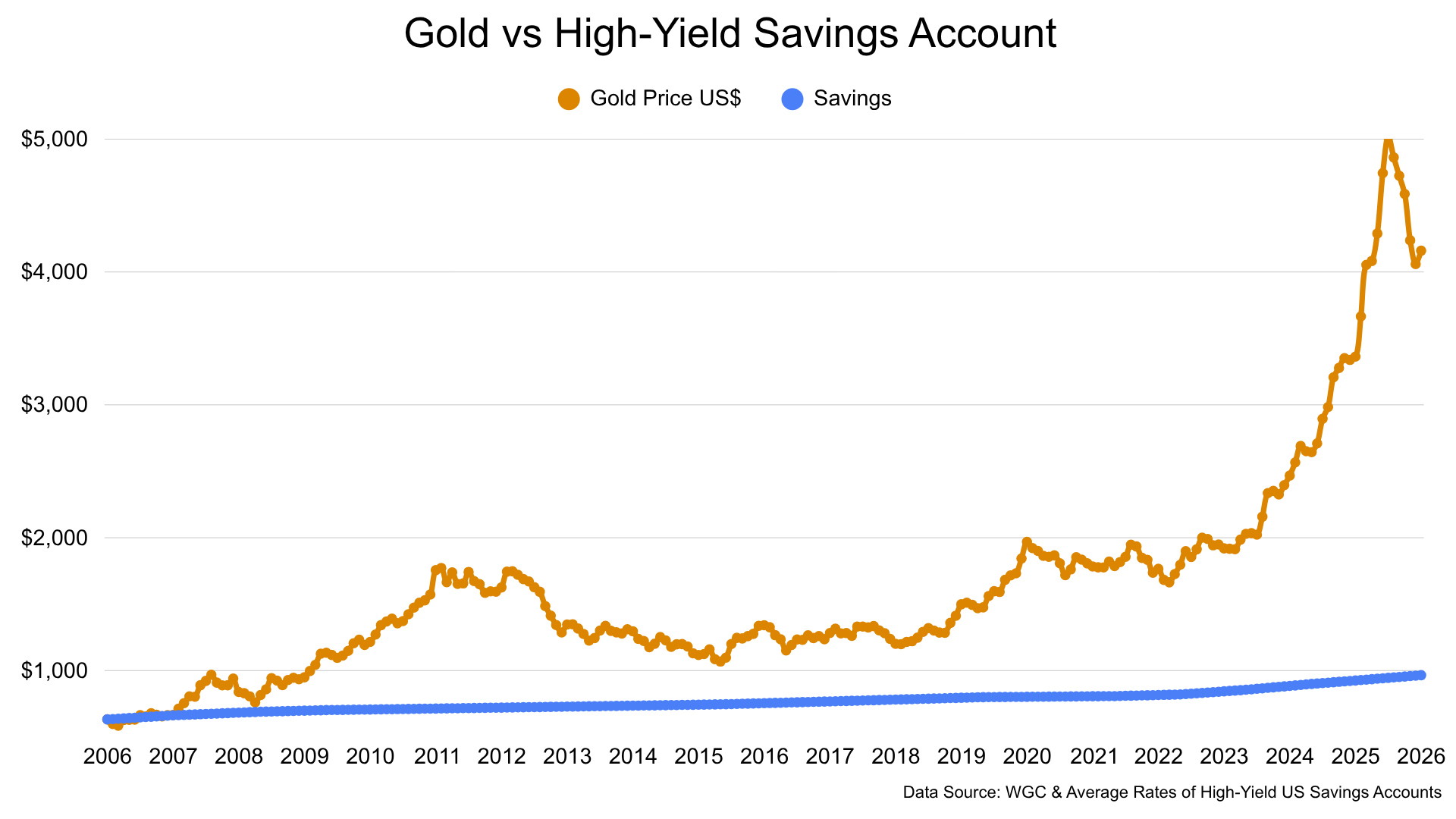
Gold prices are monthly averages sourced from the World Gold Council. Savings account figures assume interest compounded monthly at average historical high-yield US savings account rates for each period. Inflation figures are based on the US Bureau of Labor Statistics’ CPI-U index.
That gap is the whole cash-vs-gold argument in one picture. Gold didn’t just outperform cash and savings accounts, it did so by a wide margin, working out to roughly 9.9% a year for gold against roughly 2.1% a year for the savings account, compounded monthly. Put another way, gold ended this period worth more than four times the savings balance, even using a competitive high-yield rate rather than the far lower rate most traditional bank accounts actually paid.
The reason isn’t complicated: a savings account pays you back in the same currency you deposited, and that currency loses purchasing power to inflation every year regardless of the interest rate on offer. Gold isn’t denominated in any currency at all, so when a currency weakens, gold typically re-prices upward against it. Over two decades that difference compounds into the gap above.
It actually gets worse for the savings account once you account for inflation properly. Cumulative US inflation over this exact window, August 2006 to July 2026 (the latest CPI data available), was 63.8%, per the Bureau of Labor Statistics. To simply keep pace with the cost of living, that original $632.59 needed to grow to $1,035.96. It only reached $965.46. In real, inflation-adjusted terms, the “safe" option actually lost purchasing power over 20 years despite never showing a single negative month on the account statement. Gold, by contrast, is still up roughly 300% after the same inflation adjustment.
It’s worth being upfront, though, that this isn’t a straight line, and that matters for anyone comparing gold vs a savings account expecting gold to just quietly go up every year. Someone buying at the 2011 peak would have been down for several years before hitting new highs. Gold has clearly won on the numbers over 20 years, but it’s won with real volatility along the way, while cash has simply sat there, low but predictable.
How to Save in Gold Regularly
The mechanics of saving in gold come down to one simple discipline: dollar-cost averaging. Instead of trying to pick the right moment to buy, a fixed amount of money buys gold at a fixed interval, whatever the price happens to be that day, every week or every month. Some purchases land when gold is relatively expensive, others when it’s cheaper, and over time the average price paid smooths out, without ever having to guess where the market is headed next. It’s the same logic behind a workplace pension contribution, just applied to a metal, and it’s a natural fit for gold specifically since gold pays no yield to make up for bad timing, so removing the timing question altogether matters more than it would for an income-generating asset.
The practical obstacle most people hit is that gold doesn’t naturally divide into $50 or $100 chunks: coins and bars come in fixed sizes, and a fixed monthly budget rarely matches one exactly. That’s what BullionStar’s Bullion Savings Programme (BSP) is built to solve. It lets you buy gold (and silver) in gram increments rather than whole bars or coins, allowing you to build a position at a pace that suits you. When you have accumulated enough, you can even convert your BSP grams into a physical bar for delivery, collection, or storage.
AutoInvest is what turns that into an actual savings habit rather than something you have to remember to do. It lets you set an amount and a frequency, weekly, fortnightly, monthly, or quarterly and it places the purchase automatically into your BSP holding from there on. Once it’s set up, saving in gold works exactly like a standing order into a savings account, except what’s accumulating is grams of physical gold instead of currency.
Setting it up takes a few minutes: open a BSP account, choose gold, silver, or a mix of both, and set an AutoInvest amount and frequency to match your budget.
What Gold Saving Costs
It’s easy for a page making gold’s case to gloss over what it actually costs to hold it. Gold saving isn’t free, there are three real costs to weigh: no yield, the buy-sell spread, and storage.
No Yield: The Opportunity Cost
Gold pays no yield. Every dollar held in gold is a dollar not earning interest, a dividend, or a coupon anywhere else. That’s not a fee in the traditional sense, but it is a real opportunity cost, and it’s the price of holding an asset whose job is preserving value rather than generating income. Whether that trade-off is worth it comes down to the comparison earlier on this page: over the last 20 years, gold’s price gains have more than made up for the yield it doesn’t pay, but there’s no guarantee that holds true over every stretch of time.
The Buy-Sell Spread
Physical gold always trades at a small premium over the spot price when you buy, and typically a small discount to spot when you sell back, and how much depends heavily on the format. A 1-gram gold bar, for example, can carry a premium of around 40% over spot, largely down to the fixed cost of refining and minting a very small unit, while a 1-kilogram bar sits closer to 1-2%. This is exactly the cost that saving through gram-based BSP holdings is built to minimise: BSP trades at a low premium and a low spread regardless of how small the amount, since you’re not paying for a physical bar to be individually produced each time.
Storage Costs
Keeping gold at home avoids a fee but shifts the cost onto you in the form of security risk and, usually, home insurance you’ll need to arrange yourself. Professional vault storage removes that risk in exchange for an annual storage fee. In BullionStar’s Singapore vault, storing physical gold bars costs 0.39% per annum, while gold held as BSP grams costs just 0.09% per annum (0.59% and 0.19% respectively for silver and platinum). If you ever want your BSP holding as physical bars instead, converting is free, so there’s no penalty for starting in the lower-cost format and changing your mind later.
Who Gold Saving Suits (and Who It Doesn’t)
Gold saving isn’t the right fit for everyone, but the table below covers some of the things to think about if you’re unsure.
| Suits | Doesn’t Suit |
|---|---|
| Long-horizon savers (years to decades) | Anyone needing income or yield along the way |
| Those hedging currency debasement or inflation risk | Short-term savers (an emergency fund) |
| Investors prioritising capital preservation over growth | Anyone who can’t tolerate real volatility or multi-year flat stretches |
| Diversifiers already holding stocks and bonds, wanting a non-correlated store of value | Anyone needing guaranteed, stable day-to-day value |
If your money needs to be accessible, stable, and predictable within the next year or two, a savings account is still the more appropriate home for it. Gold saving earns its place alongside that, not instead of it, for money you can afford to leave alone for the long run in a diverse portfolio.
There’s also a quieter benefit worth naming: for many savers, simply not having to watch a currency’s purchasing power erode is its own kind of relief, well before you ever look at the numbers.
Frequently Asked Questions
Is gold better than a savings account?
Over the past 20 years, yes. Physical gold returned significantly more than even a competitive high-yield savings account, both before and after adjusting for inflation. Gold has been the stronger performer historically with some volatility along the way, while a savings account offers predictable, instant access to your money.
Does gold pay interest or dividends?
No. Gold pays no interest, dividend, or coupon of any kind. Any return from holding gold comes entirely from its price changing over time, which is why it suits preserving value rather than generating income.
How much should I save in gold each month?
There’s no fixed rule, since it depends on your budget and how much of your overall savings you want in precious metals rather than cash. Portfolio research often points to a 5-20% allocation to gold as a reasonable range for diversification, though hedging currency risk specifically can justify going higher. AutoInvest lets you start from a small, comfortable amount and adjust it at any time, so the more practical answer is to start with whatever you can commit to consistently and revisit it periodically.
Can I withdraw physical gold from a savings plan?
Yes. Grams accumulated through BullionStar’s Bullion Savings Programme (BSP) can be converted into physical gold bars at any time, free of charge, once your holding reaches the minimum threshold. Until then, or if you’d prefer, you can also simply sell the holding back.
Is gold saving safer than holding cash?
It depends which risk you’re weighing. Cash in a bank savings account is protected against the bank failing, up to deposit insurance limits, but it isn’t protected against inflation quietly eroding what that cash can buy. Physical gold carries no counterparty risk at all, since no one’s promise stands behind it, but its market value can fall in the short term. Gold is the safer choice against currency and institutional risk; cash is the safer choice against short-term price swings.
Start Saving in Gold
Twenty years of data make the case plainly: gold has protected and grown purchasing power in a way cash sitting in even a well-chosen savings account hasn’t come close to matching. None of that requires a large lump sum or perfect timing to get started. It just requires deciding to save a fixed amount, regularly, the same way you might for anything else.
BullionStar’s Bullion Savings Programme makes that starting point as small as you want it to be, buying gold, silver, or platinum in gram increments rather than whole bars or coins. Pair it with AutoInvest to set the amount and frequency once and let it run, and the whole process becomes no different from a standing order into a savings account, except what’s accumulating is metal that carries no one else’s promise behind it.
And whenever you’re ready to hold it directly, your BSP holding converts into physical gold bars at any time, free of charge, so saving in gold never means giving up the option of eventually holding it in your hand.
Popular Blog Posts by BullionStar
 How Much Gold is in the FIFA World Cup Trophy?
 Essentials of China's Gold Market
 Singapore Rated the World’s Safest & Most Secure Nation
 Infographic: Gold Exchange-Traded Fund (ETF) Mechanics
 BullionStar Financials FY 2020 – Year in Review
 Michael Oliver – Bond Crisis, Gold’s Bull Trend and Silver’s Breakout
 Lehman Brothers Eighteen Years On
 Jim Rogers on Why He’ll Never Sell His Gold and Silver, the Fate of the Dollar, and the Complacency That Worries Him
 Why Gold & Silver Jumped Overnight
 The Gold Paradox: One Price, Two Markets